
Discours de Chakib Alj, président de la CGEM

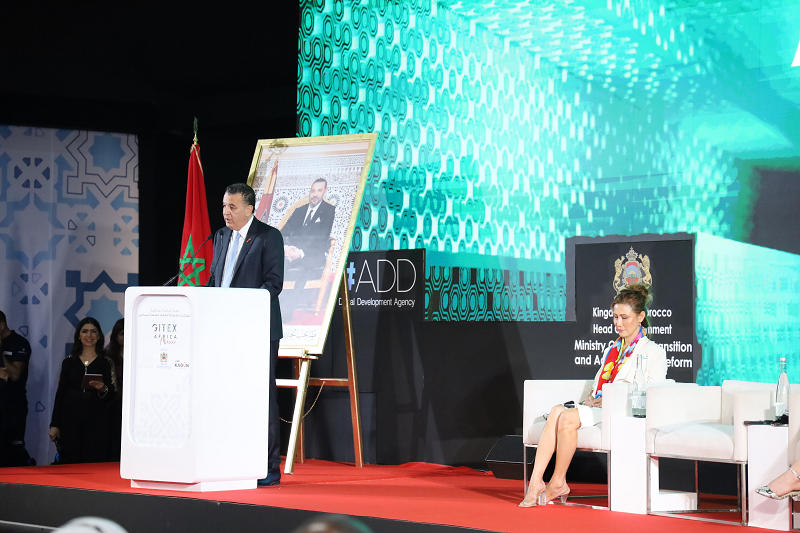
"Your Excellency Mister the Head of the Government of Morocco, Honorable Ministers, Presidents and Directors, Distinguished guests,
Ladies and Gentlemen,
I am very pleased to speak at the opening of GITEX Africa, an event that gathers high-level officials, visionary decision makers and entrepreneurs, creative minds, dreamers and doers, from all over the globe.
GITEX Africa’s choice of the magical city of Marrakesh is an affirmation of Morocco’s position as a land of innovation, resilience and impactful transformation on many levels. A transformation that radiates through the whole region and continent.
As a matter of fact, a common mindset and action were Morocco’s response to the global ongoing crisis: "In every risk lies opportunity" and "sky is the limit".
Those are also the mottos of the New Development Model of Morocco, launched by His Majesty the King Mohammed VI, may God glorify him, that puts the digital economy at the heart of its priorities.
Ladies and Gentlemen,
In an era of rapid change, countries are embracing digital transformation to accelerate economic growth, enhance the public services’ experience and empower citizens.
Three years ago, whether you were in New York, Beijing, Casablanca, or Dubai, you all lived your lives, for months, working, learning, teaching, socializing, selling, and buying online.
Technology is what kept the world going!
But like any revolution, the technological one comes with big challenges and much bigger opportunities. As an optimist, I will start with the opportunities:
One of the most significant opportunities lies in economic growth and job creation. Digital technologies can enable African businesses expand their reach in local, regional and global markets.
E-commerce platforms and digital payment systems are the catalysts of Africa's contribution to the world’s economy, but also of women and youth entrepreneurship.
Furthermore, technology can have a great impact on key sectors such as industry, agriculture, healthcare, and education in Africa:
- Precision techniques, powered by data analytics and IoT devices, can enhance agricultural productivity and food security that is much needed in the continent;
- Telemedicine and mobile health applications can fill the healthcare gap ensuring access to quality healthcare services;
- E-learning platforms and digital resources can reach students in underserved areas, facilitating access to quality education.
Another crucial sector for Africa’s development is energy. The continent has huge untapped potential in renewables, that could be used for building industry and value chains.
From improving energy production and efficiency to energy storage, smart grids and green mobility, technology is crucial.
Moreover, financial services present huge opportunities in terms of innovation and disruption. The very promising landscape of fintech in Africa is an extremely fertile ground for entrepreneurial ventures, to enhance financial inclusion in the continent and improve payment systems.
Taking into consideration all that I have mentioned, Morocco has put in place a very ambitious investment charter with remarkable incentives that aim to attract investment in major sectors.
Technology is one of them.
The Kingdom has also launched a Research and Development program to encourage investment in innovation and upscale its industry. These two assets are big steps towards the future Moroccan economy.
Ladies and gentlemen,
Technology and artificial intelligence have the potential to bring great economic benefits and change our world for the better, but can lead to inequality. Realizing the full benefit of this transition in Africa requires addressing some challenges.
The first one is Africa’s digital infrastructure gap. Despite the rising number of users, the internet penetration rate in the continent stood at around 43 percent in 2021.
Morocco is doing a good job with an internet penetration of approximately 84.1 percent, making it the country with the highest internet penetration in Africa.
Bridging this gap through targeted investment in internet infrastructure is essential. On top of that, cybersecurity and data privacy concerns must seriously be addressed to protect individuals, businesses, and the overall digital ecosystem.
Another big challenge is attracting and retaining talent. The continent must nurture and encourage its engineers and technology professionals to halt their migration. We can make African talents stay and thrive in their countries by investing in an inclusive and innovative startup ecosystem.
A vibrant tech ecosystem is also an environment where support and mentorship are available through experts and communities of entrepreneurs. For this purpose, promoting open innovation and partnerships between startups and established companies can be mutually beneficial. OCP Group, through UM6P, has a beautiful success story in the field.
Last but not least, we need to unlock funding for startups and make Africa more attractive for investors. Governments should put in place policies, dedicated financing programs and support the development of alternative financing such as crowdfunding.
And of course, events like GITEX should be duplicated to connect investors with promising startups and promote African success stories all over the world.
Ladies and gentlemen,
We are at a turning point in history. Now is the time to trust and empower our youth, now is the time to unleash the power and creativity of African entrepreneurs. We all share the belief that Africa is the continent of the future. Now it is the time to make this belief a reality.
Thank you for your attention."

à lire aussi
Article : La politique de l’eau, un enjeu de souveraineté nationale selon Nizar Baraka
Lors du MAP Town Hall organisé à Rabat, le ministre de l’Équipement et de l’Eau a détaillé cinq priorités : dessalement, interconnexions entre bassins, équité territoriale, préservation des ressources et valorisation de l’expertise marocaine à l’international.

Article : Tourisme : pourquoi l’objectif des 26 millions de visiteurs pourrait être atteint avec deux ans d’avance
Le tourisme marocain est en avance sur son propre calendrier. Alors que l’objectif officiel reste fixé à 26 millions de visiteurs en 2030, les performances récentes poussent déjà le secteur à préparer l’étape suivante : une nouvelle feuille de route pouvant viser 30 millions d’arrivées et près de 200 milliards de dirhams de recettes.
Article : Formation continue : le CESE pointe un système trop complexe et trop concentré à Casablanca
En 2022, seuls 1.647 employeurs sur près de 315.000 cotisants ont bénéficié des contrats spéciaux de formation, selon le Conseil, qui recommande un fonds dédié, la digitalisation des démarches et un meilleur accès pour les TPME et les indépendants.

Article : Bourse de Casablanca : le MASI termine en légère baisse le 3 juin 2026
L’indice principal s’est établi à 18.563,40 points, dans un volume d’échanges de 237,9 MDH sur le marché central, avec Managem, TGCC et Alliances parmi les valeurs les plus actives.

Article : La pyrite, vieux résidu minier devenu enjeu stratégique pour OCP
C’est l’histoire d’un minerai longtemps négligé qui revient au centre du jeu industriel. Alors que les prix du soufre atteignent des niveaux historiques, OCP prépare dès 2027 la récupération locale de pyrite et de pyrrhotite, avec Managem et d’autres acteurs miniers en toile de fond. Explications.

Article : Après 17 ans, Lamia El Ghorfi quitte La Mamounia pour se consacrer à un projet familial
Après dix-sept années passées à La Mamounia, Lamia El Ghorfi a annoncé son départ de la Direction de la communication et des projets culturels. Elle indique vouloir se consacrer à un projet familial, tandis que son successeur sera dévoilé dans les prochains jours.