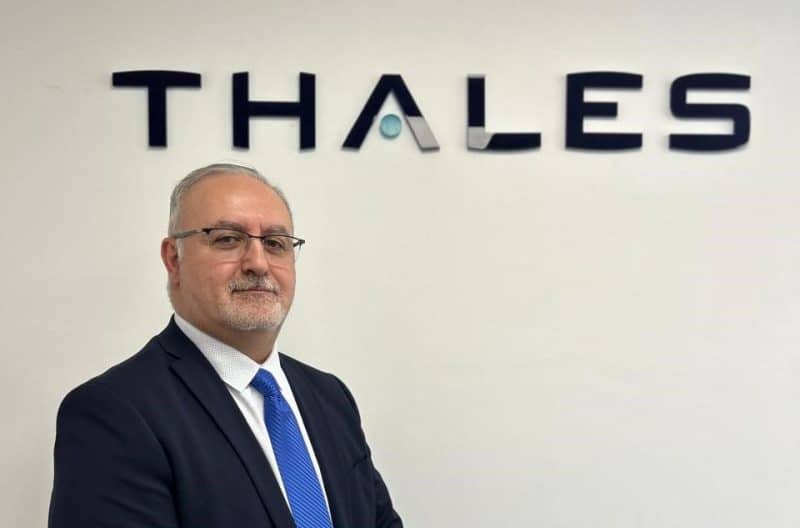
Since 2017, Thales 3D Morocco has been steadily expanding its operations in additive manufacturing. The center integrates industrial production, applied research, and technical training, and forms a key component of the group’s strategy to deepen industrial and technological integration in Morocco.
Par
Badr Elhamzaoui
Le 7 novembre 2025 à 9h07
|
Modifié 7 novembre 2025 à
16h29
Since its launch in 2017, the Thales Group’s center of excellence in Casablanca has emerged as a key player in metal 3D printing for aeronautics. Driven by steady growth, the site combines the production of high-tech components, advanced local training, and progressive integration into Morocco’s industrial ecosystem.
Yan Levy, the center's General Manager, outlined to Médias24 the group's ambitions: expanding local R&D, integrating into national industrial supply chains, and strengthening Moroccan human capital.
Additive manufacturing: a driver of industrial transformation for Thales 3D
According to our interlocutor, the center’s activity has grown steadily since its launch in 2017. The 2025 report records the production of more than 50,000 parts for the aerospace and space sectors.
"Since our establishment in 2017 and the rollout of our industrial infrastructure in 2019, we’ve produced more than 50,000 parts for various high-demand sectors in aerospace and space — averaging around 7,000 parts per year," he explains.
In the same vein, our interlocutor highlights that additive manufacturing, based on metal 3D printing, offers major advantages over conventional production methods. According to him, it fundamentally reshapes how industrial components are designed, manufactured, and optimized — particularly in the highly demanding aerospace and space sectors.
"Metal 3D printing, or metal additive manufacturing, offers key advantages over conventional methods like machining, casting, and forging. It enables complex designs, reduces weight for aerospace and space applications, shortens lead times through on-demand production, cuts waste, simplifies manufacturing steps, and allows the use of hard-to-machine alloys".
Openness, skills, and industrial integration: Thales' strategy
Strategically, Yan Levy emphasizes that Thales 3D Morocco now anchors its development within a broader dynamic of openness and integration into the national industrial fabric.
"Thales’ metal 3D factory has undergone major industrial transformation over the past two years, evolving into the group’s center of excellence — and, crucially, opening its services to external clients. Starting in 2026, the goal is to support Moroccan manufacturers as well as foreign companies setting up operations in Morocco, accounting for 30% of overall activity. Given the country’s industrial expansion, we anticipate that within five years, 50% of our operations will be dedicated to Morocco and its partners," he explains.
Regarding training, our interlocutor underscores the central role of local human capital in creating added value.
"Within the Thales 3D Morocco center of excellence, we pay special attention to ensuring that our staff — technicians, logisticians, engineers, project managers, and others — are trained to acquire the skills required by Industry 5.0. To this end, qualifying training plans and certification programs are implemented annually to ensure mastery of critical skills such as:
- 2D/3D Design;
- CAD-based modeling of physical material constraints;
- AI-driven modeling for structural defect analysis;
- 3D dimensional control and measurement (CMM);
- 5-axis machining;
- Material analysis by tomography;
- Thermal treatment of materials;
- Electrical discharge machining;
- AI-assisted animation and reverse engineering of printable parts.
The T3DM staff remains at the forefront of industrial technologies and possesses a wide range of advanced skills," emphasizes Yan Levy.
Furthermore, the group’s presence in the Kingdom goes beyond industrial production; it forms part of a broader strategy focused on skills development and technological transfer.
"For many years, the Thales group has supported Morocco’s development by expanding its activities within the regional ecosystem. This commitment is reflected in investments in local R&D — particularly in cybersecurity, identity, and biometrics — as well as in the metal 3D printing center of excellence. It also includes academic partnerships that strengthen ties with Moroccan universities and engineering schools to cultivate a pool of local talent. This strategy is further anchored in open innovation and co-development with Moroccan industrial players, leading to the emergence of continental expertise hubs and centers of excellence," explains the Thales General Manager in Morocco
"Within ten years, the T3DM center will be the continent’s essential — and quite possibly unique — player. It will showcase the high-level expertise of our teams from Morocco’s centers of excellence, and serve Morocco’s industry, its growth, and its influence across Africa," he concludes.

Si vous voulez que l'information se rapproche de vous
Suivez la chaîne Médias24 sur WhatsApp
© Médias24. Toute reproduction interdite, sous quelque forme que ce soit, sauf autorisation écrite de la Société des Nouveaux Médias. Ce contenu est protégé par la loi et notamment loi 88-13 relative à la presse et l’édition ainsi que les lois 66.19 et 2-00 relatives aux droits d’auteur et droits voisins.