
GMT+1: Social fatigue and crisis of confidence in the background (Study)
On Sunday, March 22, Moroccans switched back to GMT+1, the legal time in Morocco for several years now. The debate over this “shifted” legal time compared to the “natural” time has resurfaced. But this time, the discussion is less about clocks and more about the relationship between citizens and the state. Is this a signal worth decoding?
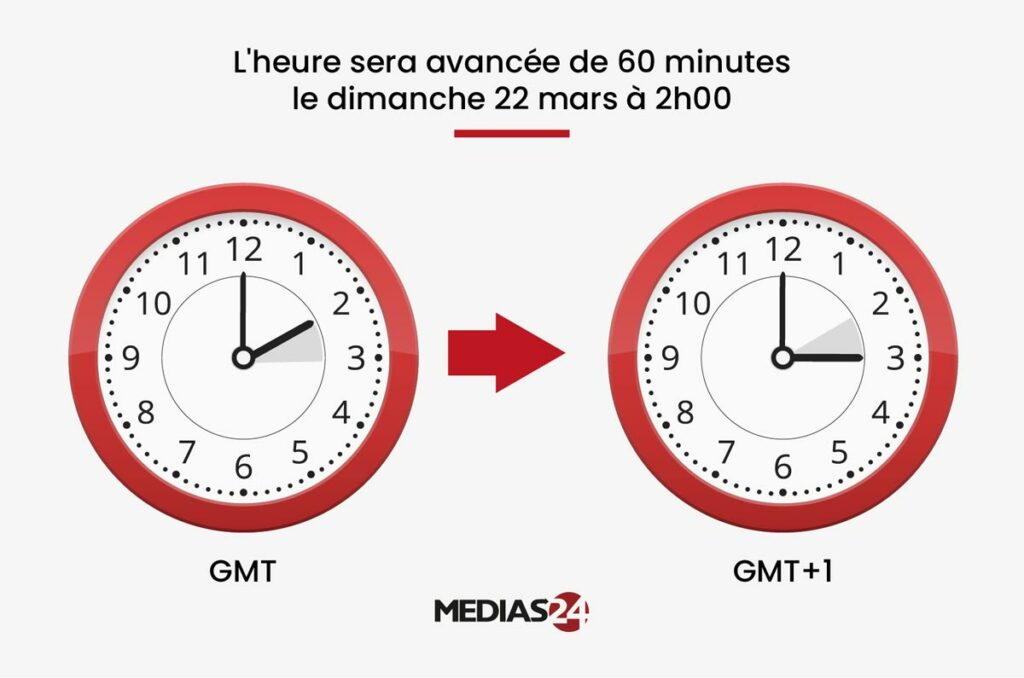
Behind the recurring debate on returning to GMT+1 after Ramadan, an analysis of more than 14,000 social media comments reveals a deeper reality: fatigue, institutional distrust, and a sense of powerlessness. For many Moroccans, the time change has become a symbol of a much broader malaise. The study was conducted by the Ach-Gal firm in March 2026.
It has now been eight years. Before October 2018, Morocco followed a classic seasonal adjustment system: GMT+1 in spring and summer, and GMT in autumn and winter.
Since October 2018, GMT+1 has been established as the legal time, with a brief return to GMT during the month of Ramadan. In practice, this system has sparked numerous criticisms—among them the fact that people wake up and send their children to school or go to work in darkness, disrupting the natural rhythm.
Over the years, these criticisms have become recurrent, and the issue has been the subject of numerous studies, surveys, and petitions. As noted in the press, the topic has become a "media chestnut," a theme that resurfaces periodically.
The study conducted by Ach-Gal highlights an evolution in perceptions, comments, and reactions: what began as simple criticism has now grown into a questioning of the relationship between citizens and the state. The debate is no longer just about time; it has become a revealing indicator of how people view their institutions. The analysis was based on 14,000 social media comments across Facebook, Instagram, and TikTok.
Five Narratives of Rejection
1. The body as a victim
"The health narrative is the most visceral in the corpus. Citizens are not debating an abstract decision, they are experiencing it in their bodies. Chronic fatigue, mild depression, children's disorientation on their way to school in the darkness"... Intensity: high.
2. “The deaf State”
"Internet users sign petitions, relay coordinated hashtags, directly address ministers, without any change occurring. The annual return to GMT+1 has become the "ritual proof" of their democratic uselessness. This narrative generates less raw anger than cynical resignation, sometimes more devastating". Intensity: high.
3. Sovereignty: An imported hour; or "France in the clocks"
For some internet users, GMT+1 is seen not as a genuinely Moroccan choice but as an alignment with French interests—particularly those of foreign actors, large multinationals, and the need for hourly coordination with France. Intensity: medium.
4. Spiritual time
One-third of the corpus draws on a religious register. The "natural" time is associated with divine blessing—the time that carries baraka. This narrative is not framed as a demand but as a cosmology. It shows that the debate over time reaches beyond fatigue or politics, touching something deeper. Intensity: high.
5. The meta-narrative: fatigue of the debate itself.
It reflects the exhaustion of digital activism. A significant portion of comments express weariness at the "annual repetition of the same cycle: the same hashtags, the same petitions, the same empty outcomes—the same tape played year after year. This narrative points to a crisis in the effectiveness of digital politics. Some voices even call for a shift from commentary to direct action: refusing to send children to school at GMT+1, or coordinating collective gestures of refusal. Intensity: low, but worth monitoring.
It's no longer anger but "political fatigue"
The emotional mapping of the comments reveals the following:
-41% exhaustion
-24% cynicism
-22% anger
-13% delegated hope
The shift from anger to cynicism is always a weak signal — but one that must be taken seriously.
Weak signals not to ignore
- The death of the petition: People no longer believe in it.
- A move toward coordinated actions, such as sending children to school at the “natural” time or unofficially working on GMT. Could this mark a shift from protest to circumvention?
The study highlights four major tensions:
1. Citizen health and well-being vs. economic interest. The only figures cited concern an annual saving of 100 million dirhams—seen as negligible compared to health and well-being.
2. Participation vs. inefficiency. Citizens engage in the debate, yet its ineffectiveness breeds weariness and resignation.
3. Sovereignty vs. multinationals. For an unauthenticated reason, a segment of public opinion is convinced that the change is driven solely by industrial multinationals operating in Morocco. Hence the invocation of sovereignty in the comments. But if that were true, wouldn’t it have been simpler for these companies to align their processes with European schedules?
4. Spirituality vs. modernity. As in many debates, spirituality is present, staged in opposition to modernity. The time debate thus becomes a clash of societal models.
The "blind spots" of the study
No credible institutional support is visible in this debate: parliament is absent. The official rationale is missing as no authority has ever presented it.
There is also a lack of economic literacy, which creates a narrative gap between the state and its citizens.
Ultimately, the study suggests that citizens want their malaise to be acknowledged—or, as some put it, their suffering during GMT+1 autumns and winters. Communication is essential.
Thus, the debate over GMT+1 is neither technical nor merely about time. It is political, cultural, and almost existential. And as long as it is treated as a simple matter of time management, it will continue, year after year, to generate the same anger—and the same deadlock.

à lire aussi
Article : Le Honduras décide de suspendre sa reconnaissance de la “rasd”
Le Honduras a annoncé la suspension de sa reconnaissance de la pseudo “rasd”, une décision officielle notifiée à Rabat et aux Nations Unies.

Article : Engrais. Sous pression à cause du blocus d’Ormuz, l’Inde se tourne massivement vers le Maroc
Entre le blocus d'Ormuz qui paralyse la production indienne, les restrictions chinoises à l'export et la crise agricole américaine, le marché mondial des engrais phosphatés traverse une période de turbulences sans précédent. Dans ce contexte, l'Inde, plus exposée que jamais à la désorganisation des flux, consolide sa dépendance au Maroc.

Article : Hôtellerie : Marriott nomme Denis Laus à la tête du futur resort de Taghazout Bay
Prévu pour l’été 2026 aux portes d’Agadir, l’établissement comptera 250 chambres avec vue sur l’océan, plusieurs espaces de restauration et 600 m² dédiés aux réunions et événements.
Article : La réforme des Groupements sanitaires territoriaux cherche ses preuves sur le terrain
Cinq directeurs généraux nommés par le Roi, des indicateurs présentés comme probants dans une région pilote, mais des syndicats qui contestent et des décrets toujours manquants. La réorganisation du système de santé public marocain autour de groupements sanitaires territoriaux s'accélère. Le plus dur reste à faire.
Article : Casablanca : le Mégarama dément tout projet de démolition sur le front de mer
Le Mégarama de Casablanca ne fait l’objet d’aucun projet de destruction, a indiqué à Médias24 une source autorisée au sein de l’établissement, réagissant à des informations relayées en ligne sur une possible démolition de plusieurs installations du littoral.
Article : SIAM 2026 : Maroc Telecom dévoile ses solutions Agritech pour une agriculture intelligente
Partenaire officiel du SIAM, Maroc Telecom présente ses dernières innovations Agritech fondées sur l’IoT, l’intelligence artificielle et la 5G, afin d’accompagner la transformation digitale du secteur agricole.