
Morocco-Spain. Sebta, Melilia and the fiction of a Moroccan-American front to reclaim the enclaves
Against a backdrop of unprecedented tensions between Madrid and Washington over the use of Spanish military bases in the war against Iran, parts of Spain’s public debate have revived the specter of Morocco reclaiming Sebta and Melilia with U.S. support. Fueled by certain political positions and amplified by media coverage, the hypothesis remains, at this stage, more fantasy than real diplomatic momentum.
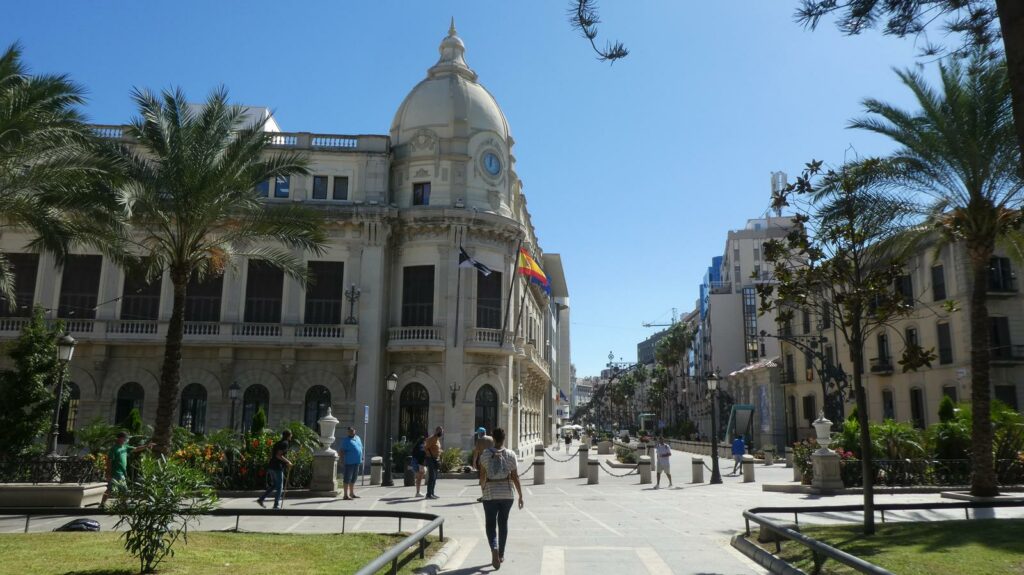
To say the least, relations between Spain and the United States are not in good shape.
At the root lies a series of disagreements, intensified by Spain’s opposition to Washington’s use of the military bases it operates on Spanish soil for its war against Iran. There are two such bases: Rota, located on the Costa de la Luz (province of Cádiz), and Morón, inland from Seville.
On March 2, 2026, two days after the start of U.S. strikes against the “Islamic Republic”, Spanish Foreign Minister José Manuel Albares personally appeared on the public broadcaster RTVE to announce that Spain “will not authorize the use of the bases for anything that does not comply with the United Nations Charter.” The position was later reiterated by his colleague in Pedro Sánchez’s government, Defence Minister Margarita Robles.
In response, U.S. President Donald Trump, as early as March 3, 2026, on the sidelines of his talks with German Chancellor Friedrich Merz at the White House, declared that his administration would “end all trade with Spain” and that it “wanted nothing more to do with it.” At the same time, fifteen U.S. aircraft were redeployed from Rota and Morón to other countries, including Germany and France, according to data from the reference site FlightRadar24.
But Washington could now go even further, potentially suspending Spain from the North Atlantic Treaty Organization (NATO), of which the country has been a member since May 1982. This was revealed on Friday, April 24, 2026 by Reuters, citing an internal Pentagon email — that is, from the U.S. Department of Defense. The message, signed by Elbridge Colby, Under Secretary of Defense for Policy in the Trump administration, essentially reproaches Spain for having violated what it describes as the “absolute foundation” of NATO by denying the U.S. military access to Rota and Morón. These so-called “ABO” rights — for access, basing and overflight — refer to the ability granted to allied countries to access territory, station forces and conduct overflights in order to carry out or support military operations.
It should also be noted that well before the Iranian crisis, Spain had already found itself repeatedly in Trump’s crosshairs for its steadfast refusal to raise military spending to 5% of gross domestic product (GDP). “Maybe we should, frankly, exclude them from NATO,” the U.S. president warned as early as October 9, 2025, in the presence of his Finnish counterpart Alexander Stubb. Five days later, he told journalists at the White House that he was “very unhappy” and “not satisfied” with Spain, stressing that it was “the only country that has not raised its [military spending] to 5% of GDP.”
And all the while, even as the dispute appears, in light of all these elements, strictly American-Spanish, many circles on the southern shore of the Strait of Gibraltar have increasingly turned a suspicious eye toward Morocco. The reason? Sebta and Melilia.
Sebta and Melilia in Spain’s political noise
On March 16, 2026, Michael Rubin, a former Pentagon official and now an analyst at the conservative think tank American Enterprise Institute (AEI), caused a stir by calling, in an op-ed, on Moroccans to recover their presidios through a “New Green March.”
Half-serious, half-demonstrative, his core argument was that if Sánchez kept raising the issue of the decolonization of the occupied Palestinian territories — Rubin, it hardly needs stating, is pro-Israel — he would do better to start by putting Spain’s own house in order by returning to their rightful owner all the fragments it still holds along Morocco’s coastline, illegitimately. He also recalled that Sebta and Melilia are not covered by the North Atlantic Treaty, as they are not located in Europe, arguing that any attempt by Rabat to retake them by force would not trigger Article 5 of NATO, which stipulates that an attack on one member is considered an attack on the entire alliance.
In Spain, some were quick to seize on the remarks, especially as a certain narrative had already been emerging in the country, particularly on the right and far right: that Morocco could take advantage of the current rift between Spain and the United States to advance its claim over Sebta and Melilia. This narrative has been further fueled by the broad-based rapprochement between Morocco and the United States observed since December 2020, when the tripartite agreement including Israel was signed in Rabat.
Thus, on March 17, 2026, Jorge Campos Asensi, a Vox MP from Majorca (Balearic Islands), warned in a conspiratorial tone in the Spanish Senate of the “constant American and Israeli support at the international level” for Morocco, claiming that the fate of Sebta and Melilia was “at stake.” In the same vein, a non-legislative proposal — in other words, a non-binding motion — was introduced in the same chamber by both Vox and the Popular Party (PP) “for the defense of Spanish sovereignty in Sebta and Melilia (sic).”
Meanwhile, several media voices known for their anti-Moroccan stance also entered the fray. One can think in particular of the online outlet “El Español”, which as early as February 23, 2026 had published an article warning of a “New Green March” on Sebta and Melilia backed by Trump — perhaps inspiring Rubin’s later intervention. More recently, El Independiente, where propagandist Francisco Carrión is notably active, opened its pages to Algerian pro-regime journalist Akram Kharief, alias “Secretdifa3”, amplifying the siege-like anxiety within Spanish public opinion over a possible U.S. alignment with Morocco on the presidios issue.
At an official level, however, Madrid has sought to firmly dismiss any notion that Morocco might rely on the United States to decolonize Sebta and Melilia. “It’s completely absurd,” Albares said on April 7, 2026 on the Spanish program “Al Rojo Vivo”, as we previously reported.
But one point stands out: on the Moroccan side, there has been complete silence throughout — no official or unofficial comment from Rabat.
Why Rabat is choosing silence
It is true that since the tripartite agreement, relations between Morocco and the United States have never been better. This is clearly illustrated by the recent signing, on April 14, 2026 in Washington, of a new military cooperation roadmap (2026–2036), even though the previous roadmap, dating from October 2020, still had four years left to run. The terms of this joint defense framework have also evolved significantly, with Morocco increasingly positioned as a new regional security anchor in the western Mediterranean, backed by U.S. political and military support.
But to imagine that Rabat would involve its ally in the Sebta and Melilia issue? At this stage, that remains largely a groundless fantasy — for several reasons. The first is simply that Morocco-Spain relations are currently at what Albares himself has described as a “historical high level.”
At the core lies Madrid’s new position, formalized by Sánchez in March 2022, recognizing the Moroccan autonomy plan as the “most serious, realistic and credible basis” for resolving the Sahara dispute — effectively amounting to de facto support for Morocco’s territorial integrity. Symbolically, alongside Portugal, Morocco and Spain are also co-hosting the 2030 FIFA World Cup, an event meant to further integrate the northern and southern shores of the Strait.
Naturally, this does not mean that Morocco has renounced its historical claims over Sebta and Melilia. It is worth recalling that in December 2020, then Prime Minister Saâd Dine El Otmani stated on Saudi channel Acharq that after the Sahara, the presidios would eventually be next. When the Moroccan ambassador to Madrid, Karima Benyaïch, was subsequently summoned by the Spanish government, she confirmed that this was indeed the official position of the Moroccan state — that Sebta and Melilia rightfully belong to Morocco. Furthermore, in a largely unknown measure, holders of Moroccan diplomatic passports, while exempt from visas for Spain under a bilateral agreement dating back to July 1997, are not allowed to use them to enter Sebta and Melilia — a form of non-recognition of Spanish sovereignty over the two cities.
Beyond this “spirit of the times”, which sees Morocco refraining from publicly pressing its claims, there is also, more discreetly, a longstanding gentleman’s agreement between the two countries dating back to November 1975, when the Madrid Accords were negotiated for the retrocession of the Sahara. According to this understanding, Rabat would refrain from demanding Spain’s withdrawal as long as Spain itself had not recovered Gibraltar, under British sovereignty since the Treaty of Utrecht (1713). This was revealed by King Hassan II during a press conference on November 25, 1975, and the underlying logic is that Spain could not simultaneously control all three “keys” of the Strait of Gibraltar — Gibraltar itself, as well as Sebta and Melilia. “Spain works for Morocco when it claims Gibraltar, because if it recovers the Rock, we will recover Sebta and Melilia,” the late monarch told Arab journalists in April 1980.
This likely explains why Sánchez stated, with such certainty, in April 2022, shortly after being received at the Royal Palace in Rabat by King Mohammed VI, that Spain’s “territorial integrity” was “beyond doubt”, in response to a question about the presidios.
There is, however, another fundamental dimension that is becoming increasingly difficult to ignore: while the presidios, as Spanish enclaves, were viable as long as they functioned as an intermediary commercial zone between Morocco and Spain, this model has become increasingly strained over time, in light of the projects implemented in recent years by Rabat — from the Fnideq economic activity zone adjacent to Sebta to the new port of Beni Nsar near Melilia. “Morocco now sets the terms in cross-border relations with Spain,” acknowledged in July 2025 the president of Melilia, Juan José Imbroda.

à lire aussi
Article : Automobile : le Chinois Haomei New Material investit 690 MDH au Maroc
Le spécialiste chinois de l'aluminium Haomei New Material s'apprête à investir 510 millions de yuans pour construire une nouvelle base de production à Tanger. Ce projet vise à soutenir l'industrie des véhicules électriques sur le marché européen.

Article : OPCVM : les encours atteignent 846,7 MMDH à fin avril 2026, en hausse de 14,7% depuis janvier
Portés par une nouvelle hausse hebdomadaire, les encours des OPCVM atteignent 846,7 milliards de dirhams au 24 avril 2026, poursuivant leur progression dans un contexte de flux toujours orienté vers les supports monétaires et obligataires court terme.
Article : Justice : le Maroc et l’Autriche veulent renforcer leur coopération judiciaire
Le Maroc et l’Autriche ont réaffirmé, le lundi 27 avril 2026 à Rabat, leur volonté de renforcer leur coopération judiciaire, à l’occasion d’une rencontre entre le ministre marocain de la Justice, Abdelatif Ouahbi, et la procureure générale de la République d’Autriche, Margit Wachberger.
Article : Lancement à Tafraout des travaux d’un hôpital de proximité pour 227 MDH
Le futur établissement disposera de 45 lits et devra couvrir près de 70.000 habitants de la province de Tiznit, avec des services allant des urgences à la maternité, en passant par la chirurgie, la pédiatrie et l’imagerie médicale.
Article : SIAM 2026 : plus de 1,13 million de visiteurs
1.136.952 visiteurs, 1.590 exposants, 76 pays et 538 coopératives... la 18ᵉ édition du Salon international de l’agriculture au Maroc (SIAM) prend fin ce 28 avril à Meknès.

Article : Nouveau système d’entrée en Europe. Grève de 24 heures le 5 mai, les transporteurs marocains passent à l’action
Réunis le lundi 27 avril, les transporteurs routiers internationaux de marchandises ont décidé d’observer un arrêt de travail de 24 heures à partir du 5 mai, principalement au niveau de Tanger Med. Le mouvement, lié aux difficultés croissantes d’accès au marché européen, pourrait affecter près de 2.500 camions sur une journée normale.