
Despite a challenging environment, Lekjaâ forecasts 5.3% growth and a deficit cut to 3%
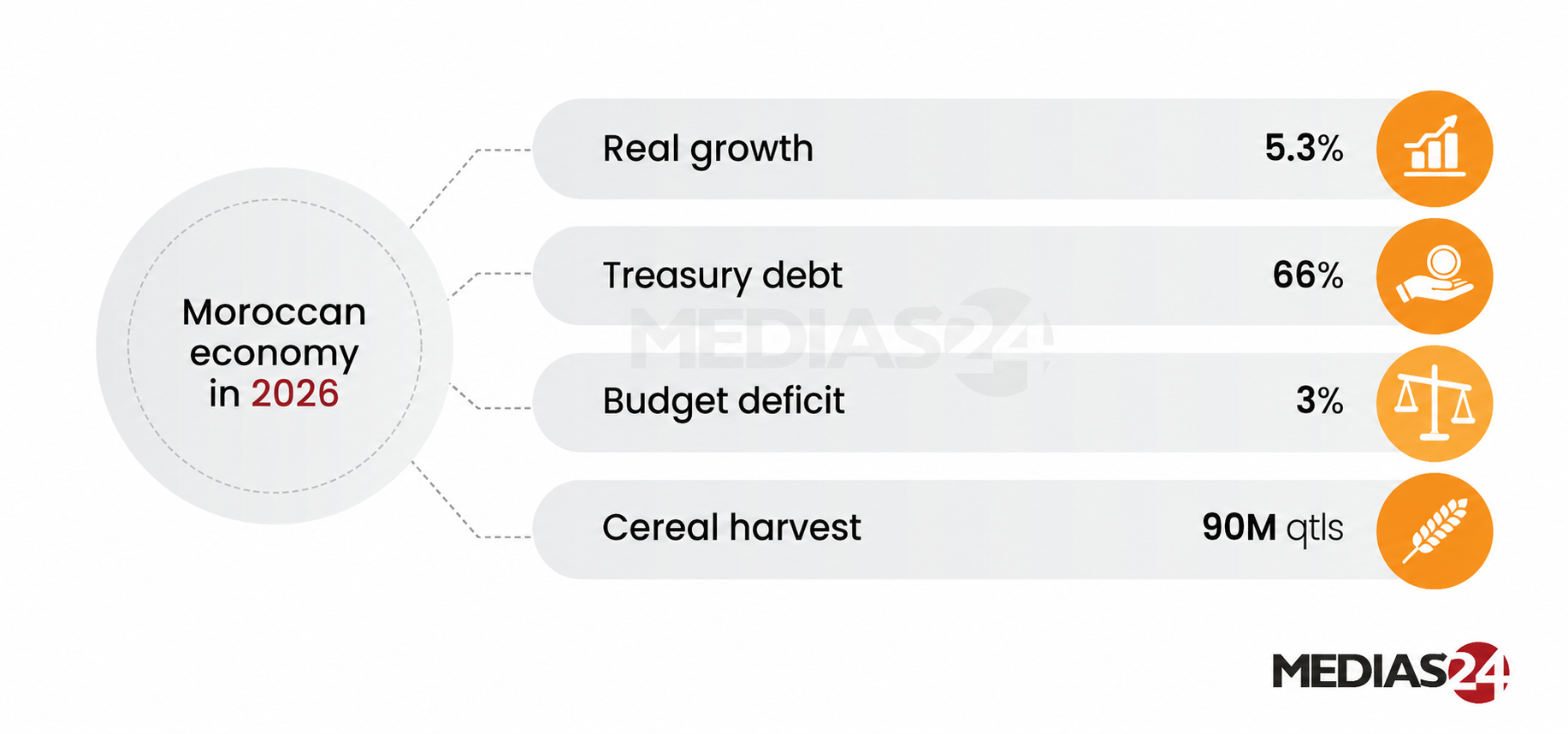
Fouzi Lekjaâ expects growth of around 5.3%, partly driven by the agricultural rebound. According to him, this momentum should help bring the budget deficit down to 3% of GDP and stabilize Treasury debt at around 66%.

Growth, budget deficit, Treasury debt, the agricultural season, inflation, etc. Fouzi Lekjaâ presented, on May 12, 2026, before the House of Councillors, a favorable outlook for Morocco’s economy in 2026.
Robust growth despite a difficult environment
Growth comes first. It is the key indicator, the one that best captures the pace of economic activity. "The Moroccan economy is expected to record a growth rate of around 5.3% in 2026, despite the current environment and constraints," Lekjaâ said.
If this figure is confirmed, the Moroccan economy would record its strongest growth rate, excluding the post-Covid rebound, since 2008, when growth reached 6%.
At first glance, this level may seem counterintuitive. The international context remains tense, geopolitical uncertainties persist, particularly in the Middle East, and the external environment remains unfavorable. But a closer look at Morocco’s growth record, and especially at its main drivers, shows that a rate above 5% is not unrealistic.
Indeed, this year, two major drivers of Moroccan growth are coming together: agricultural value added and public investment, two engines that are expected to support activity in 2026.
The agricultural season looks promising and should contribute significantly to growth. Its share in overall value added generally ranges between 9% and 10%. On this point, Lekjaâ said the 90 million quintals expected from the cereal harvest should make a significant contribution to projected growth.
"This year has been marked by significant rainfall and an improvement in the country’s hydrological situation after six consecutive years of drought, pointing to good prospects for the 2025-2026 agricultural season. Cereal production is expected at around 90 million quintals, paving the way for a reassessment of growth prospects. According to macroeconomic forecasts, each additional 20 million quintals of cereals is likely to generate between 0.2 and 0.3 percentage points of growth".
Following this logic, a harvest of 90 million quintals in 2026 would represent an increase of 46 million quintals compared with the 44 million estimated for 2025. The direct gain from the cereal harvest would therefore be around 0.7 percentage points of growth*.
It is also worth noting that, for several years, the forecasts of the Ministry of Economy and Finance on economic growth have generally remained very close to the final figures later published by the High Commission for Planning (HCP).
The trajectory of the deficit and debt
When growth accelerates, fiscal ratios become easier to stabilize. In the same vein, Lekjaâ expects a continued improvement in the Treasury’s deficit and debt ratios. The deficit is expected to be reduced to 3% of GDP in 2026, while Treasury debt is expected to stabilize at around 66% of GDP.
"This controlled financial situation, made possible by the fiscal space created by stronger revenues and spending control, will allow us to reduce the budget deficit to 3% of GDP by end-2026, an improvement of around 0.5 percentage points compared with 2025. As a result, the level of Treasury debt, relative to GDP, will continue its downward trajectory and stabilize at around 66% in 2026," the minister said.
With a real growth assumption of 5.3% and inflation that Lekjaâ expects to rise slightly in 2026, nominal growth should be strong enough to help bring these ratios down. It should be noted, however, that the nominal component of growth depends on the general price level, which is not the same as CPI-measured inflation.
For Lekjaâ, this downward trend in fiscal ratios is also due, beyond the growth effect, to the improvement in ordinary revenues observed in recent years.
"This situation extends the significant improvement in ordinary revenues observed over the past five years. These rose from MAD 256.2 billion in 2021 to MAD 424.2 billion in 2025, an increase of MAD 168 billion. This reflects average annual growth of 13.5%, driven in particular by the notable increase in tax revenues, whose average annual growth rate reached 12.4%," he said.
-oOo-
* If every additional 20 million quintals generates 0.3 percentage points of growth, then an additional 46 million quintals should contribute around 0.69 percentage points of growth: (46 / 20) x 0.3 = 0.69 pt.

à lire aussi

Article : AS FAR-Mamelodi Sundowns (Ligue des champions) : quelle heure, quelle chaîne
L'AS FAR affronte Mamelodi Sundowns, ce dimanche 17 mai 2026, en finale aller de la Ligue des champions de la CAF.

Article : Sur instructions royales, Lalla Meryem préside le Conseil d'administration des Oeuvres Sociales des FAR
En exécution des instructions du Roi, Chef Suprême et Chef d'État-Major Général des Forces Armées Royales, la Princesse Lalla Meryem a présidé, samedi au siège de l'État-Major Général des FAR, le Conseil d’Administration des Œuvres Sociales des FAR.
Article : Réforme de la profession d'avocat. Le texte adopté en commission embrase les barreaux
La commission parlementaire de la Justice a adopté jeudi une série d'amendements au projet de loi réformant la profession d'avocat. Le texte acte des avancées sur l'accès à la profession et l'immunité de la défense, mais cristallise de nouvelles tensions. Les bâtonniers des dix-sept barreaux du Royaume annoncent leur démission collective et menacent de bloquer toute élection professionnelle.

Article : Saad Lamjarred condamné à 5 ans de prison en France
L'artiste marocain a été condamné, vendredi 15 mai, à une peine de cinq ans de prison dans le cadre de l'affaire de viol d'une fille à Saint-Tropez, dans le sud-est de la France, en 2018.

Article : Arrestation à M'diq d’un ressortissant norvégien recherché par Interpol
Un citoyen norvégien de 72 ans, recherché à l’international pour blanchiment d’argent, a été interpellé près de M'diq par la BNPJ. Il fait actuellement l’objet d’une procédure d’extradition.

Article : La FRMF officialise le changement de nationalité sportive de Bouaddi, désormais sélectionnable pour le Mondial
Une annonce qui tombe certainement au meilleur moment pour le sélectionneur national, Mohamed Ouahbi.