
What’s at Stake in Libya?
PRINCETON – The ongoing war in Libya is a microcosm of the tragedy that has gripped many Middle Eastern countries. If it is not resolved soon, the fighting in Libya could sow instability in neighboring countries like Tunisia and Egypt, and trigger more waves of refugees fleeing to Europe.
At root, the Libyan crisis is a civil war among various groups that are divided by tribal and regional loyalties, as well as by ideological beliefs. All are vying to control the country’s oil revenues. Yet, at the moment, there are principally two sides to the conflict: the Islamist-dominated, internationally recognized Government of National Accord (GNA), which still controls the capital, Tripoli; and the Tobruk-based House of Representatives and the Libyan National Army (LNA), which are under the command of the anti-Islamist field marshal Khalifa Haftar. While most of the country is now under the authoritarian nationalist Haftar’s control, Tripoli has yet to fall.
Behind each of these warring camps are outside powers pursuing their own interests. While Turkey and Qatar have backed the GNA, Egypt, Russia, and the United Arab Emirates have been lending support to Haftar. International media coverage of the war has attributed this outside interference to competition – mainly between Turkey and Egypt – for oil and gas resources.
The Egyptians have a gas project that could potentially link up with facilities in Israel, Cyprus, and Greece to supply Europe. But that objective directly conflicts with Turkey’s goal of creating an exclusive maritime zone with Libya, and of securing sole control over Libya’s energy resources.
But the contest over energy is not the whole story. To understand the Libya conflict fully, one also must consider the complex links between geopolitics and ideology. A victory for the Islamists in Tripoli would allow Turkey and Qatar not only to extend their influence into a major oil-producing state on the Mediterranean; it also would offer them strategic depth, strengthening their influence over other countries such as Tunisia and Egypt (a longtime rival).
Hence, for most of the war, Qatar has sponsored the Islamists, mainly by providing financial support to a single person: the religious activist and scholar Ali Muhammad al-Salabi. With the help of Qatar’s resources, al-Salabi has emerged as the GNA’s de facto leader. But late last year, the GNA appeared to be on the verge of defeat, leading to Turkey’s intervention on its behalf. Turkey has since committed weapons, drones, soldiers, and even Syrian fighters to the battle for Tripoli.
On the other side of the divide, Egypt and the UAE do not want to see a petrostate capable of producing 2.5 million barrels per day fall into the hands of Islamists who are beholden to their regional rivals. A victory for the GNA would turn Libya into an Islamist stronghold and a beachhead for undermining Egypt and the UAE’s authoritarian vision for the region. Haftar – a uniformed and heavily ornamented military dictator straight out of central casting – would establish an order much more to their liking. If he is victorious, Libya’s oil resources could then be leveraged in the broader fight against the Islamist bogeyman across the region.
Russia’s motive for siding with Haftar is more intriguing, but can be summed up in one word: revanchism. Although Russian President Vladimir Putin has sent mercenaries (mainly those associated with the paramilitary Wagner Group) to join the fight, Haftar himself is not the Kremlin’s top candidate to rule Libya. Putin wants to install Saif al-Islam Qaddafi, the son of the late Libyan dictator, Muammar el-Qaddafi, who ruled the country from 1969 to 2011.
With the support of former regime loyalists, Qaddafi has joined forces with Haftar. But the Russians do not trust Haftar, because they regard him as a US intelligence asset, owing to his previous life as an American citizen who lived in Langley, Virginia (incidentally, the site of CIA headquarters) for two decades. By making Qaddafi Libya’s next ruler, the Kremlin hopes to prove a point to the Americans and Europeans who helped to topple his father. Following his success in keeping Syrian President Bashar al-Assad in power despite overwhelming odds, Putin wants to show that it is he who will dictate Libya’s future and call the shots in the region. If the clock really is set back to Moscow time, it will be interesting to see what happens to Haftar.
The complex situation in Libya is verging on the surreal. Unfortunately, the same cannot be said for the very real suffering of the Libyan people, who are caught between the competing factions. For its part, the United States has been negligent in its approach to the crisis, which it has largely ignored in the hope that other regional powers will restore order. In fact, those powers are the ones sowing chaos, and only the US has the diplomatic leverage to end the conflict.
Should Libya’s civil war continue, its effects will undoubtedly spill over to other parts of the region. More refugees will flee to Europe, especially if the conflict turns out to be a harbinger of civil wars to come. Tunisia, Algeria, Sudan, or Lebanon could become the next theater for regional and international powers to fight proxy wars while fantasizing about becoming the Arab world’s next hegemon. As the rubble that is now Syria makes clear, to the victor will go spoils that no longer justify the effort.
à lire aussi
Article : Le Canada reconnaît le plan d’autonomie proposé par le Maroc comme base pour une solution du différend régional autour du Sahara marocain
Le Canada "reconnaît le plan d’autonomie" proposé par le Maroc "comme base pour une solution mutuellement acceptable" au différend régional autour du Sahara marocain.

Article : Secteur privé. Le grand manque à gagner pour l’économie marocaine (Banque mondiale)
La Banque mondiale accorde une large place au secteur privé dans son rapport croissance-emploi sur le Maroc. Si le Royaume a su préserver une stabilité macroéconomique et maintenir un niveau d’investissement élevé sur les deux dernières décennies, cette dynamique ne se traduit pas suffisamment en productivité, en emploi formel durable et en revenus privés.
Article : Chatbot Médias24. La Banque mondiale publie son diagnostic du secteur privé au Maroc
Le rapport "Diagnostic-pays du secteur privé", élaboré par le Groupe de la Banque mondiale et publié ce mardi 28 avril 2026, vise à identifier les opportunités d’investissement privé inexploitées ainsi que les obstacles connexes. Il analyse les moyens de stimuler l'investissement privé au Maroc pour favoriser une croissance inclusive et créer des emplois de meilleure qualité. Explorez le document via ce chatbot.
Article : Hydrocarbures au Maroc. Et si l'on cherchait au mauvais endroit ?
Et si le Maroc était à l'aube de son "moment norvégien" ? Une étude scientifique récente plaide pour un changement de paradigme des cibles d’exploration offshore au Maroc et révèle que les ressources les plus importantes pourraient se cacher dans des cibles négligées jusqu'alors. Un pari à tenter ?
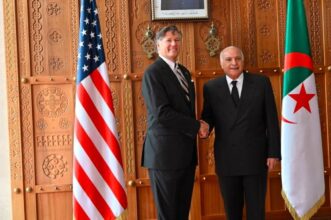
Article : Christopher Landau à Alger : le Sahara marocain au cœur des échanges, sur fond de soutien croissant à l’autonomie
La visite du secrétaire d’État adjoint américain Christopher Landau à Alger intervient dans un contexte de consolidation des soutiens internationaux à la souveraineté du Maroc sur le Sahara, alors que Washington maintient sa position en faveur de l’initiative marocaine d’autonomie.

Article : Enseignement supérieur. La promesse d’une hausse de 1.000 DH nets remise en cause ?
La revalorisation salariale de 1.000 DH annoncée dans l’enseignement supérieur suscite de vives tensions avec les syndicats. Les modalités de calcul de cette augmentation sont jugées inéquitables et engendrent des disparités importantes entre les fonctionnaires.