
Between ethics and innovation, Moroccan advertising in search of sovereignty
The first National Advertising Conference, which opened on Wednesday, October 8 in Casablanca, marks a turning point for an industry seeking regulation, ethics, and independence in the face of digital giants.
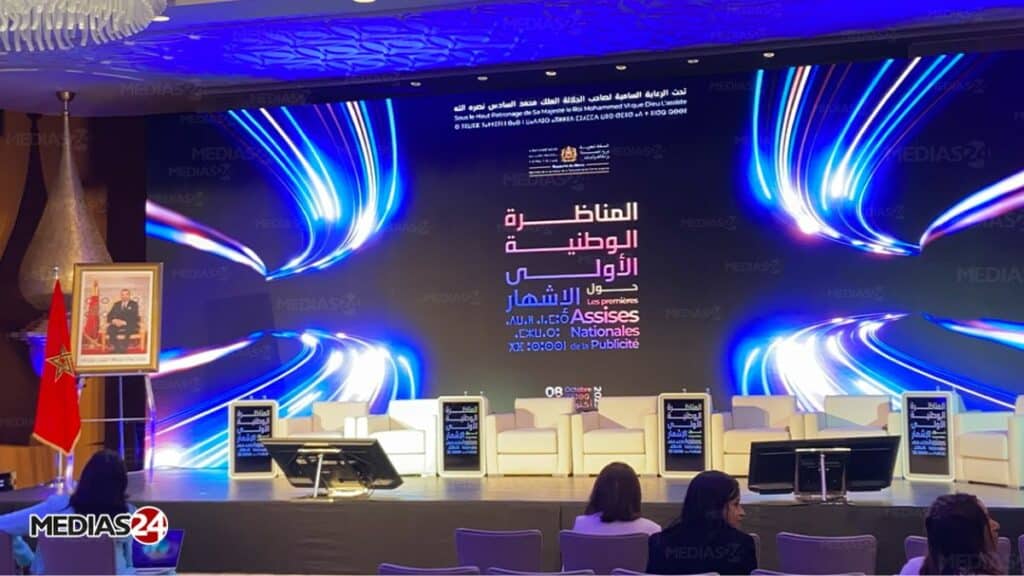
Held under the theme “State of Affairs and Perspectives”, the conference’s opening session delivered an uncompromising diagnosis of the sector and outlined pathways for ambitious reforms.
In his address, the Minister of Youth, Culture, and Communication, Mehdi Bensaid, presented a strategic vision, describing advertising as a “pillar of digital and media sovereignty.”
By fully integrating the sector into Morocco’s “path of emergence,” he set a clear target: to raise the contribution of cultural and creative industries (CCI) from 2.7% to 5% of GDP by 2030. This ambitious goal seeks both to “rebalance the relationship with major multinationals” and to put an end to the “drain of imaginations.”
Diagnosis of a sector under digital scrutiny
Aziz Khiyati, Director of Budget at the Ministry of Economy and Finance, speaking on behalf of Fouzi Lekjaa, Delegate Minister in charge of the Budget, described a "fragmented national advertising market" confronted by "consolidated and largely dominant global digital platforms."
He pointed out Morocco’s “persistent technological dependence,” particularly regarding audience measurement and monetization tools, which remain controlled by foreign providers.
This imbalance has a direct financial impact. “The value being created is increasingly dissipating abroad,” he warned, noting that GAFAM capture over 80% of global advertising investments — a trend that is confirmed in Morocco.
Call for "speaking truthfully": ethics and governance in question
Latifa Akharbach, President of the High Authority of Audiovisual Communication (HACA), delivered one of the most incisive speeches of the morning, urging the audience to “adopt speaking truthfully in this new Moroccan era.” In a passionate address, she framed her vision around three major concerns:
> Ethics of advertising discourse
Latifa Akharbach emphasized that advertising is “above all a narrative” that “creates and consecrates social representations and norms.” She stressed the “fundamental principle of strict separation between advertising content and editorial content,” highlighting HACA’s determination to strengthen its vigilance in this area.
> Economic governance of the market
The HACA President challenged the current economic model of public broadcasting. “The scarcity of advertising resources and the real economic difficulties of the media must find other solutions,” she said, adding that “the economic model of public broadcasting must rely on adequate, stable, and predictable funding, free from constraints related to advertising pressure.”
> Sovereignty in the face of the digital realm
Describing the situation as a “major challenge” rather than a “destiny,” she pointed to global platforms that “largely escape national regulations.” She called for coordinated action, particularly at the African level, and proposed concrete measures such as “specific taxation on platform advertising revenues” so that “a portion of the captured value is redistributed in favor of national media and local production.”
Paths to solutions: strategy, regulation, and innovation
In response, public actors outlined strategies for reconquest. Ilham Hraoui, speaking on behalf of SNRT CEO Faïçal Laraïchi, recalled that a “restructuring of the Moroccan public sector” is underway. A key initiative is the creation of a “single agency capable of optimally managing all the media of the public holding,” directly addressing market fragmentation.
She also highlighted innovation as a tool of sovereignty, citing the VOD platform Forja, a “100% local product” that has already reached 4 million downloads. This initiative reflects the ambition to “build premium local Moroccan platforms” capable of competing with foreign giants.
The first National Advertising Conference will continue until October 9.

à lire aussi
Article : Prévisions météorologiques pour le lundi 20 avril 2026
Voici les prévisions météorologiques pour le lundi 20 avril 2026, établies par la Direction générale de la météorologie (DGM): - Températures en hausse avec temps […]

Article : Dette hybride. Au-delà de la levée, le modèle et les contraintes d’OCP
Derrière le succès de son émission obligataire hybride d’avril 2026, le groupe OCP révèle une équation financière complexe. Entre montée de la fiscalité, politique de dividendes, investissements massifs dans la transition verte et dans des activités hors cœur de métier, le champion des phosphates doit désormais arbitrer dans un environnement compliqué.
Article : Un nouveau “dictionnaire critique” pour relire le Maroc colonial
Un ouvrage collectif dirigé par l’anthropologue marocain Hassan Rachik propose une relecture de la période coloniale à travers un format original de dictionnaire, réunissant une vingtaine de chercheurs marocains, français et espagnols.
Article : Sahara: despite Algiers’ efforts, Washington’s position remains unchanged
On the sidelines of the Antalya Diplomacy Forum in Turkey, Algeria’s foreign minister and the U.S. president’s senior advisor for Arab and African affairs discussed several regional issues, including the Sahara. Yet behind the carefully worded Algerian statement, Washington’s support for Morocco’s territorial integrity remains clear and unchanged. Since December 2020, that position has taken on the weight of state continuity, suggesting it will endure regardless of political turnover in Washington or diplomatic initiatives from Algiers.
Article : Santé animale : Biopharma et le Tchad passent à la phase opérationnelle de leur partenariat
La société pharmaceutique marocaine Biopharma a signé à N’Djamena une feuille de route de coopération avec l’Institut tchadien de recherche en élevage pour le développement (IRED), dans le cadre du renforcement de la coopération maroco-tchadienne dans le domaine de la santé animale.

Article : Casablanca : les autorités démentent auprès de Médias24 une rumeur sur une fermeture des commerces à 23 heures à Anfa
Les autorités ont démenti, auprès de Médias24, l’existence d’une décision imposant la fermeture des commerces, cafés et restaurants à 23 heures dans le ressort de la préfecture d’arrondissements de Casablanca-Anfa, après la circulation d’informations en ce sens sur certains sites et réseaux sociaux.