Moving around during AFCON 2025: choosing the right mode of transport
Following your team from one city to another, reaching a stadium from the airport, or simply visiting Morocco’s iconic landmarks — during AFCON 2025, efficient travel will make all the difference. Plane, train, bus, taxis, ride‑hailing services, or car rental: here is the essential information to move easily, safely, and make the most of the competition.
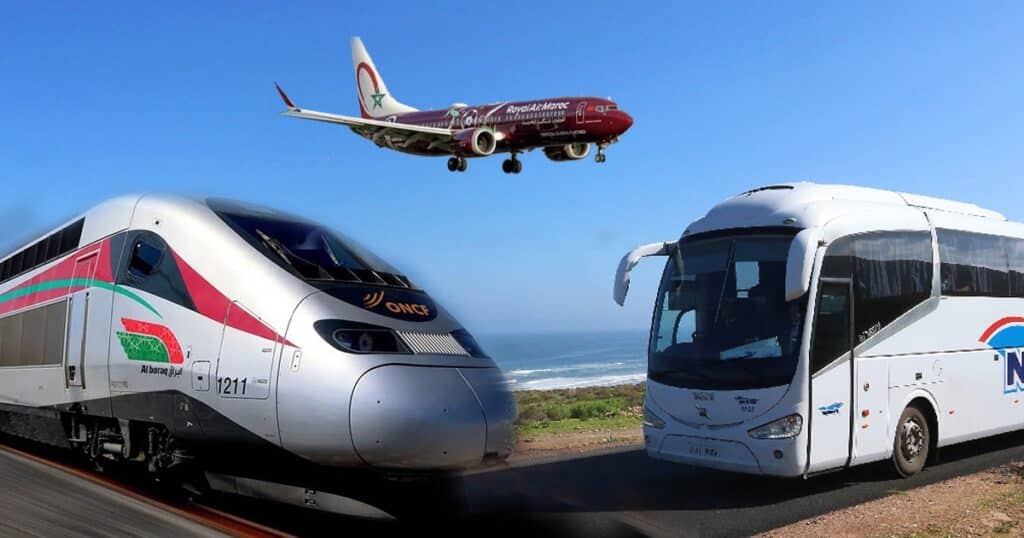
When preparing a trip to AFCON 2025 in Morocco, one key issue is how to move between host cities, within each city, and from the airport to your hotel.
Depending on your budget, comfort, or need for flexibility, several options are available: plane, train, bus, taxi, ride‑hailing services, or car rental — each with its advantages.
AFCON 2025 will be played in six host cities: Rabat, Casablanca, Tangier, Fez, Marrakech, and Agadir. Each has its own airport and multiple transport options, allowing you to combine different modes according to your schedule.
Traveling between host cities: the plane, the time-saving option
If you have matches scheduled in distant cities (for example Tangier → Agadir or Fez → Marrakech), flying is often the fastest way.
Airports in host cities:
- Casablanca: Mohammed V Airport (CMN)
- Rabat: Rabat–Salé Airport (RBA)
- Tangier: Ibn Battuta Airport (TNG)
- Fez: Fez–Saïss Airport (FEZ)
- Marrakech: Marrakech–Menara Airport (RAK)
- Agadir: Al Massira Airport (AGA)
Airlines and domestic connections
- Royal Air Maroc and Air Arabia Maroc operate most domestic flights
- Casablanca (CMN) is the main hub, with many routes transiting through it
- Some routes are direct (e.g. Casablanca–Agadir, Casablanca–Marrakech), others require a connection
- Air Arabia also operates internal flights from Rabat
Flight durations and indicative prices (AFCON routes)
As Casablanca is the main domestic hub, it is often the simplest starting point — or transit — to connect the host cities.
Here is an overview of available flights, durations, and indicative prices for Royal Air Maroc and Air Arabia.
Flights operated by Royal Air Maroc (data collected on December 10, 2025): (Booking portal link)
> From Casablanca (CMN)
- Casablanca → Agadir (CMN–AGA): ≈ 1 h–1 h 25 direct. One‑way ~700 DH, round trip ~1300 DH. Prices rise significantly during AFCON or for late bookings.
- Casablanca → Tangier (CMN–TNG): ≈ 1 h 15–1 h 20 direct. One‑way ~1200 DH, round trip ~2300 DH. Fares increase quickly on match days. Note: the Al Boraq TGV is often more cost‑effective on this route.
- Casablanca → Fez (CMN–FEZ): ≈ 1 h 10 direct. One‑way ~800 DH, round trip ~1700 DH.
- Casablanca → Marrakech (CMN–RAK): ≈ 55 min–1 h direct. One‑way ~1000 DH, round trip ~2000 DH.
> Other routes:
Agadir is the southernmost host city, making the choice between direct flights and layovers crucial.
- Tangier → Agadir (TNG–AGA): with layover, ~1600 DH one‑way, ~3300 DH round trip. Via Casablanca (TNG→CMN→AGA), total travel time can reach 6 h door‑to‑door, or longer depending on layovers.
- Fez → Agadir (FEZ–AGA): ~1399 DH one‑way, up to ~2800 DH round trip. Always involves at least one connection, with durations ranging from ~5 h to over 26 h.
- Tangier → Marrakech (TNG–RAK): with layovers, fares from ~1994 DH one‑way to ~4000 DH round trip. Travel times vary between ~5 h 40 and over 26 h.
Additionally, some connections from Rabat operated by Air Arabia are available but limited.
Flights operated by Air Arabia (data collected on December 10, 2025): (Booking portal link)
- Rabat → Agadir (RBA–AGA): ≈ 1 h 05–1 h 15 direct, ~712 DH one‑way, ~1145 DH round trip
- Tangier → Agadir (TNG–AGA): ≈ 1 h 20 direct, ~1500 DH one‑way, ~1900 DH round trip
- Fez → Agadir (FEZ–AGA): ≈ 1 h 15 direct, ~433 DH one‑way, ~810 DH round trip
For routes not served directly, rail or road alternatives are often more relevant — generally faster, more economical, and better suited for travel between host cities during AFCON.
Practical advice for flying during AFCON
On domestic routes, travel time often depends on layovers. A slightly more expensive direct flight is usually better than an itinerary via Casablanca, which can add fatigue, waiting time, and extra cost. Booking early is key to keeping fares low.
- Book early: prices rise quickly during AFCON and the best schedules sell out fast
- Check for layovers: long waits can cancel out the time saved by flying
- Airport transfers: some airports are outside city centers (e.g. Agadir, Marrakech)
- Travel light: cabin baggage saves money and time at boarding
- Rabat–Casablanca: too close for flying — train, taxi, or car are better options
When to choose the plane?
- If you have limited time between matches in distant cities
- If traveling with family or a group and want to avoid long journeys
- If train or bus schedules do not fit your itinerary
ONCF trains: Morocco’s travel backbone
If you plan to visit several cities to attend matches or explore the country, the ONCF rail network is the simplest option — city center to city center, fast and convenient. It connects major coastal hubs and inland destinations, making it an excellent base for supporters.
ONCF will also offer special deals and packages for fans during AFCON 2025. (Train ticket booking link)
The network operates two types of trains useful for the tournament:
- Al Boraq (high‑speed line): Tanger–Kénitra–Rabat–Casablanca axis
- Classic Intercity trains: linking Fez and Marrakech to the rest of the network
Why is the train useful during AFCON?
- Frequent connections between Casablanca, Rabat, Tangier, and Fez
- Comfortable travel, with stations located in city centers
- Flexible alternative to flying, often just as fast door‑to‑door once airport transfers are considered
Tip: on some routes, trains are almost as fast door‑to‑door as planes, once transfers are factored in.
Al Boraq high‑speed line: the ultra‑fast northern axis of AFCON
Al Boraq is Africa’s first high‑speed rail, linking Tangier to Casablanca via Kénitra and Rabat‑Agdal.
For supporters, it is the most efficient option if you have matches in the north or center.
- Frequency: trains run almost every hour from 6 a.m. to 9 p.m. in both directions
- Tickets: available online or at stations
Classic ONCF trains: essential for Fez and Marrakech
Classic trains complement the LGV, covering most AFCON routes — especially Marrakech and Fez. Agadir, however, is not served by rail; for that city, prefer plane, CTM/Supratours bus, or car.
- Casablanca → Marrakech (direct): ≈ 2 h 45–2 h 58. One‑way: ~135–160 DH (2nd class) / ~150–215 DH (1st class)
- Casablanca → Fez (direct): ≈ 3 h 50–4 h 00 (sometimes longer depending on stops). One‑way: ~155–165 DH (2nd class) / ~200–240 DH (1st class)
- Rabat → Fez (direct): ≈ 2 h 50–3 h 00. One‑way: ~115–125 DH (2nd class) / ~120–175 DH (1st class)
- Tangier → Fez (direct): ≈ 4 h 30–5 h. One‑way: ~110–125 DH (2nd class) / ~135–165 DH (1st class)
Interurban buses: reliable complement to the rail network
When the train does not serve a destination — or if you are looking for the lowest fare — the coach is a reliable option. Morocco has a dense network, with daily departures linking all major cities.
The two main operators are CTM and Supratours (ONCF), both recognized for their reliability and comfort.
Why choose the bus during AFCON?
- Maximum coverage: especially useful for Agadir (no train service in 2025) and for transversal routes
- Controlled budget: often cheaper than train or plane
- Central bus stations: arrivals are usually close to city centers
Durations + indicative prices on useful AFCON bus routes
Prices and travel times vary with season and demand; here are the most common ranges:
- Marrakech → Agadir (CTM / Supratours): ≈ 3 h 30. From ~120 DH one‑way
- Tangier → Marrakech (CTM): ≈ 9 h (long but direct). ~250–360 DH one‑way
- Casablanca → Marrakech (CTM): ≈ 3 h on fastest routes. Tickets from ~95 DH, usually ~100–160 DH
- Marrakech → Fez (CTM): ≈ 7 h 30. ~230–260 DH one‑way
Comfort: not all buses are equal
Some operators offer better comfort than others — reclining seats, air‑conditioning, luggage storage — and make it easier to reach cities that can be difficult to access otherwise.
- CTM: modern fleet with reclining seats, air‑conditioning, luggage compartments, and sometimes Wi‑Fi
- Supratours: same level of reliability, convenient for coordinating with ONCF train arrivals and departures
- Other private companies: service quality varies, sometimes decent, sometimes more random
Moving around host cities: taxis, ride‑hailing, and short trips
In major cities like Casablanca, Rabat, or Marrakech, grand taxis remain an affordable option for short interurban trips just beyond the city limits.
In recent years, ride‑hailing apps such as Careem or inDrive have gained popularity. They offer:
- Fixed prices: no need for negotiation
- Transparency: clear fares before departure
- Comfort: often superior to traditional taxis, especially useful if you arrive late at night or prefer predictability
Grand taxis: for short interurban trips
- Use: connections between nearby cities or suburbs
- Pricing: no meter; pay per seat if shared, or the full fare if privatized
- AFCON interest: useful for short routes not practical by train (e.g. outskirts, distant stadiums)
Ride‑hailing apps (Careem, inDrive, Yango...)
- Advantages: upfront pricing, no negotiation, good comfort — convenient if you arrive late or with luggage
- Availability: mainly in major cities (Casablanca, Rabat, Marrakech, Tangier, Fez…)
Car rental: maximum freedom, especially in groups
For those who value autonomy — or who travel with family or friends — renting a car remains an attractive option. It lets you move at your own pace, explore less accessible areas, and avoid the constraints of bus or train schedules. Keep in mind, however, that it requires planning — driving, fuel, and stops at gas stations.
Indicative prices (per day):
- Compact: ≈ 150–300 MAD in low season; higher during AFCON
- Compact/intermediate: ≈ 300–500 MAD
- SUV/premium: ≈ 500–800+ MAD depending on the model
Conditions and documents
- License: a national license is sufficient if in the Latin alphabet; otherwise, an international license is recommended
- Age: most agencies require drivers to be 21–23 years old, with higher limits for premium models.

à lire aussi
Article : La politique de l’eau, un enjeu de souveraineté nationale selon Nizar Baraka
Lors du MAP Town Hall organisé à Rabat, le ministre de l’Équipement et de l’Eau a détaillé cinq priorités : dessalement, interconnexions entre bassins, équité territoriale, préservation des ressources et valorisation de l’expertise marocaine à l’international.
Article : Tourisme : pourquoi l’objectif des 26 millions de visiteurs pourrait être atteint avec deux ans d’avance
Le tourisme marocain est en avance sur son propre calendrier. Alors que l’objectif officiel reste fixé à 26 millions de visiteurs en 2030, les performances récentes poussent déjà le secteur à préparer l’étape suivante : une nouvelle feuille de route pouvant viser 30 millions d’arrivées et près de 200 milliards de dirhams de recettes.
Article : Formation continue : le CESE pointe un système trop complexe et trop concentré à Casablanca
En 2022, seuls 1.647 employeurs sur près de 315.000 cotisants ont bénéficié des contrats spéciaux de formation, selon le Conseil, qui recommande un fonds dédié, la digitalisation des démarches et un meilleur accès pour les TPME et les indépendants.

Article : Bourse de Casablanca : le MASI termine en légère baisse le 3 juin 2026
L’indice principal s’est établi à 18.563,40 points, dans un volume d’échanges de 237,9 MDH sur le marché central, avec Managem, TGCC et Alliances parmi les valeurs les plus actives.
Article : La pyrite, vieux résidu minier devenu enjeu stratégique pour OCP
C’est l’histoire d’un minerai longtemps négligé qui revient au centre du jeu industriel. Alors que les prix du soufre atteignent des niveaux historiques, OCP prépare dès 2027 la récupération locale de pyrite et de pyrrhotite, avec Managem et d’autres acteurs miniers en toile de fond. Explications.

Article : Après 17 ans, Lamia El Ghorfi quitte La Mamounia pour se consacrer à un projet familial
Après dix-sept années passées à La Mamounia, Lamia El Ghorfi a annoncé son départ de la Direction de la communication et des projets culturels. Elle indique vouloir se consacrer à un projet familial, tandis que son successeur sera dévoilé dans les prochains jours.