Rachid Guerraoui: “Morocco is not bound to technological vassalage”
Invited to the 12/13 special edition at Gitex Africa in Marrakech, Rachid Guerraoui, professor at the Swiss Federal Institute of Technology in Lausanne (EPFL), delivers a pragmatic analysis of the effects of artificial intelligence on employment, digital sovereignty, and Morocco’s strategic choices.
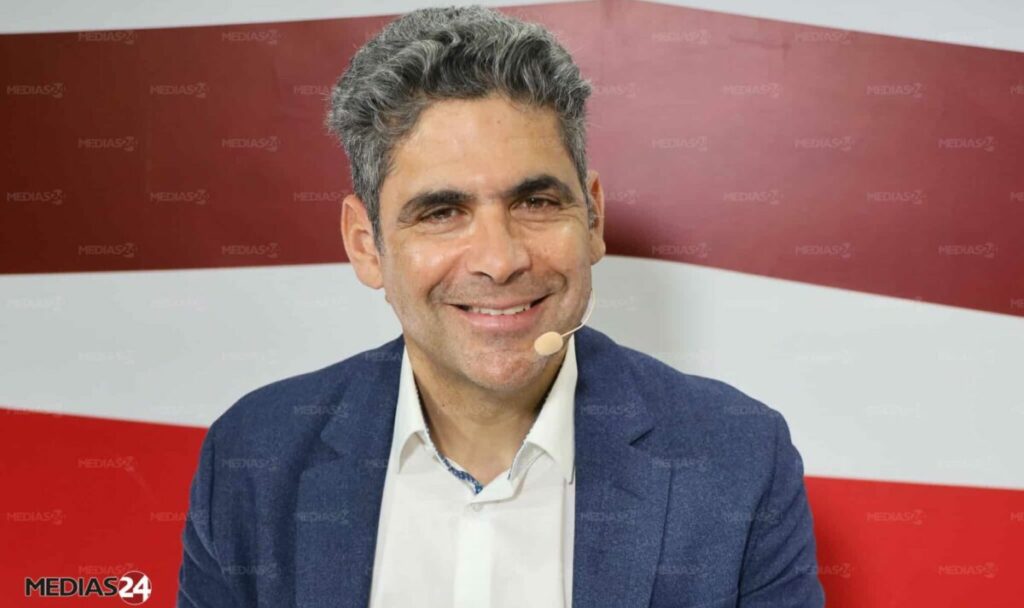
On the 12/13 special Gitex set broadcast live from Marrakech, Rachid Guerraoui highlighted the real risks associated with AI, while defending a clear stance: investing in knowledge, focusing on concrete projects, and locally adapting existing solutions to avoid imposed technological dependence.
Médias24. The title of your masterclass was deliberately provocative: 'Are we doomed to unemployment and vassalage in the age of artificial intelligence?' Does AI today represent a genuine risk of dependence for a country like Morocco?
Rachid Guerraoui. This masterclass and its title were chosen jointly with the Swiss Embassy in Morocco, which proposed the event. There are strong ties between the two countries in terms of knowledge exchange. Agreements exist between the Swiss Federal Institute of Technology in Lausanne and Mohammed VI University in Morocco. In this context, raising a question centered on knowledge made perfect sense.
Are we doomed to unemployment and vassalage in the age of AI? There is indeed a risk — a major one. Opinions in this field remain divided, yet some are stark and alarming. They suggest that countries, whether developed, developing, or underdeveloped, could face an extreme threat of widespread unemployment.
- In the case of Morocco, what is your assessment?
- In the case of Morocco, once again, scientific predictions in general — and in this field in particular — remain highly complex and uncertain.
Clearly, there is a risk for certain professions, but I remain optimistic, because in Morocco, as I mentioned earlier, we have invested in knowledge. We have highly skilled people — engineers, technicians. We will need to ride this wave.
I remain relatively optimistic, thinking that yes, some sectors will be affected, but overall, if we manage to channel our knowledge towards what could make us a driving force in this field, then perhaps good days lie ahead.
- Are we still in a scenario where some countries produce the technologies, hence the tools and solutions of AI, while others only consume them? Where does Morocco stand objectively today?
- Clearly, there are two countries that produce these technologies: the United States and, in recent years, China. These are the two producers, while the rest of the world consumes. Yet, there are different ways of consuming.
- Even Europeans consume?
- Yes, even Europeans consume. Although there are attempts in Europe to compete — with French, German, and other initiatives — they remain consumers. However, not everyone is doomed to vassalage. In Morocco, one can ride this wave intelligently.
Without getting too technical, one can, so to speak, download existing open‑source AI solutions available to everyone, adapt them to the local context, deploy them on local machines, and almost disconnect from the Internet — in other words, ensure a certain degree of sovereignty.
- A relative sovereignty...
Yes, but it is possible. It means we should move in that direction rather than signing blind agreements with American partners — I have nothing against the United States in particular — or with producers of these technologies, without mastering our own part, which could be a downloaded component, as I said, from the Internet, from open‑source platforms. So I believe we are not condemned to vassalage.
- Let’s return to employment and to the risks — or opportunities — that AI represents for jobs in a context such as Morocco’s. Opinions differ on its impact: will it destroy more jobs than it creates? The same question arises for professions linked to offshoring. In your view, where does the truth lie? Does the balance lean more towards risk or opportunity?
- Honestly, I have absolutely no idea. What seems to me to be one of the paths to salvation is, first, manual work. I think we have not yet reached the stage where AI can... I would not entrust my head or beard to scissors handled by a robot — we are not there yet.
And we are not there, not only for reasons of responsibility or emotion, but because AI still cannot represent the physical world as it does with text, where it has shown extraordinary capabilities.
So, manual jobs are not close to being replaced. As a country, we have every interest in strengthening these professions through vocational training that could integrate AI tools. The plumber, the electrician, the hairdresser, the nurse — these are, in my view, professions we should encourage.
Secondly, there are the professions of AI designers. Today, engineers at Google or DeepMind earn more than Hakimi. For the first time in history, these people are paid fortunes because they are rare. If, in Morocco, we develop — and we can — advanced profiles capable of building Moroccan AI, they will find work.
So, on the one hand, vocational training; on the other, AI experts. But I believe there are also people in between — those who stand at the intersection between AI and the real world. For example, in the medical field, it is clear that the doctor of tomorrow must know how to use conversational systems, tools like these. They need to train for that. Yet, if the doctor knows how to use these tools and understands their limitations, they have nothing to fear for their future.
The same goes for lawyers. But, as you mentioned, there may be professions — certain branches of outsourcing or translation — that will need to be complemented by other skills beyond simply translating or automatically responding to people. Adaptation is essential, using AI tools.
- There is another central issue: that of value creation. Who actually captures the wealth generated by artificial intelligence?
- Today, contrary to what many may think, 95% of AI projects fail. So we are still at a stage of very low added value, except for a few major players. Clear economic benefits have not yet appeared.
However, I still believe these benefits will eventually come. It is up to us to be agile enough — and above all to launch projects — saying: let’s focus, for instance, on recommendation systems for tourism in Morocco, or on new forms of traffic management in Morocco.
Launching projects like these and focusing on them could, if successful, make us exporters of a type of computing — for me, AI is computing — adapted to the Moroccan or African context.
- Specifically, let’s talk about Morocco. The country has strong ambitions in terms of digital sovereignty, digital transition, and artificial intelligence. But, sincerely, are these ambitions realistic given the Moroccan context?
- I think it is important to express these ambitions. It is already good to state that we want to achieve them, because many countries are saying they will go back to the age of pen and paper — and that is dangerous. Burying our heads in the sand is not a solution.
Expressing these ambitions matters. We have the brainpower. We have extremely well‑trained engineers. Moroccan schools — ENSIAS, EMI, UM6P — produce extraordinary individuals, as do Moroccans from X or École Polytechnique. So we have that.
- Now, what do we lack?
- I think we sometimes lack concrete projects to embark on — and it’s fine if they don’t succeed. These projects should be entrusted to local actors. In my view, we need to take a leap and say: we want to create such and such an IT system for electronic signatures, or to stop legalizing documents as we still do — tangible projects that address real needs for Moroccans. And if it doesn’t work, that’s okay.
- This calls for a change in mindset, American-style...
- We need to trust local actors. Once again, perhaps in partnership with foreign players, directly or indirectly, by downloading this software. But, in my opinion, we must stop thinking that we have to partner with digital giants for everything we do in this field in our country.
- Returning to the concept of vassalage, with a specific question: what should Morocco, as a country, do to avoid this technological vassalage? What should be its strategic priorities?
- Once again, we need to be very pragmatic. Many companies and individuals in Morocco use what are called conversational agents — ChatGPT, Gemini, and others.
I think: why not, once again, entrust certain Moroccan sectors, whether private or public, with running open‑source models — which are no less good than ChatGPT or Gemini — in Morocco, within a Moroccan context, and offer them to Moroccan companies and citizens?
We need incentives, as they say. We must encourage them to do so. But I believe we need to take that step. There are technical solutions that allow us to deploy models, conversational agents, on Moroccan territory with just a few machines and a few GPUs.
- This is what the Chinese have practically done with DeepSeek.
- Exactly — this is what the Chinese have done with DeepSeek. And what I didn’t even think was possible with just a few machines has now become possible. We have technical solutions that would allow us, with four or five machines, to run some of the world’s largest models in specific sectors in Morocco.
Of course, we won’t be responding to millions of requests per second — but a Moroccan administration doesn’t need to. There may be hundreds of requests, and there are software solutions available. It’s up to us to take the plunge and make it work.
- There is often talk of the need to adopt responsible, ethical AI — AI in the service of citizens. But how can innovation, economic performance, and responsibility be reconciled in its development?
- My opinion may not be very politically correct, but I think we are very small players. How could we possibly decree that we will create ethical AI? We simply don’t have all the cards in hand.
What we can do, once again, is at least ensure that AI is deployed and contextualized within our country. Then, perhaps, we can hold certain citizens or companies accountable when they use it — for instance, when someone posts something defamatory on Facebook, being able to say: be careful, this is defamation, and trace the person behind it.
But declaring and decreeing that ethical AI is needed… France cannot do it, Germany cannot do it, and the United States doesn’t want to. So who are we to set ourselves up as the world’s policemen? These are postures. Unfortunately — and I say unfortunately because it matters — they are doomed to fail.
- Let's go back to the title of your masterclass. Are we doomed to failure when it comes to AI in the Moroccan context?
- No, I don’t think at all that we are doomed to failure. We must keep investing in knowledge. We’ve taken the lead ahead of many countries, and we must continue in that direction.
It would also be good, in my view, for our engineers — I often tell them — to read books, to learn what we call soft skills, and so on. Because the future will lie at the intersection between the virtual world and the real one.
The classic computer engineer, locked in their room doing pure programming, risks being overtaken by the machine. But the engineer who understands the real world — who can talk about biology, who can talk about geology — will be much harder to replace.
So yes, I’m optimistic. We have strong training programs. We must keep moving forward and take the plunge with concrete projects.
à lire aussi
Article : La politique de l’eau, un enjeu de souveraineté nationale selon Nizar Baraka
Lors du MAP Town Hall organisé à Rabat, le ministre de l’Équipement et de l’Eau a détaillé cinq priorités : dessalement, interconnexions entre bassins, équité territoriale, préservation des ressources et valorisation de l’expertise marocaine à l’international.

Article : Tourisme : pourquoi l’objectif des 26 millions de visiteurs pourrait être atteint avec deux ans d’avance
Le tourisme marocain est en avance sur son propre calendrier. Alors que l’objectif officiel reste fixé à 26 millions de visiteurs en 2030, les performances récentes poussent déjà le secteur à préparer l’étape suivante : une nouvelle feuille de route pouvant viser 30 millions d’arrivées et près de 200 milliards de dirhams de recettes.
Article : Formation continue : le CESE pointe un système trop complexe et trop concentré à Casablanca
En 2022, seuls 1.647 employeurs sur près de 315.000 cotisants ont bénéficié des contrats spéciaux de formation, selon le Conseil, qui recommande un fonds dédié, la digitalisation des démarches et un meilleur accès pour les TPME et les indépendants.
Article : Bourse de Casablanca : le MASI termine en légère baisse le 3 juin 2026
L’indice principal s’est établi à 18.563,40 points, dans un volume d’échanges de 237,9 MDH sur le marché central, avec Managem, TGCC et Alliances parmi les valeurs les plus actives.

Article : La pyrite, vieux résidu minier devenu enjeu stratégique pour OCP
C’est l’histoire d’un minerai longtemps négligé qui revient au centre du jeu industriel. Alors que les prix du soufre atteignent des niveaux historiques, OCP prépare dès 2027 la récupération locale de pyrite et de pyrrhotite, avec Managem et d’autres acteurs miniers en toile de fond. Explications.

Article : Après 17 ans, Lamia El Ghorfi quitte La Mamounia pour se consacrer à un projet familial
Après dix-sept années passées à La Mamounia, Lamia El Ghorfi a annoncé son départ de la Direction de la communication et des projets culturels. Elle indique vouloir se consacrer à un projet familial, tandis que son successeur sera dévoilé dans les prochains jours.