
Fallen not far from Khémisset, a freshly identified meteorite reveals its first secrets
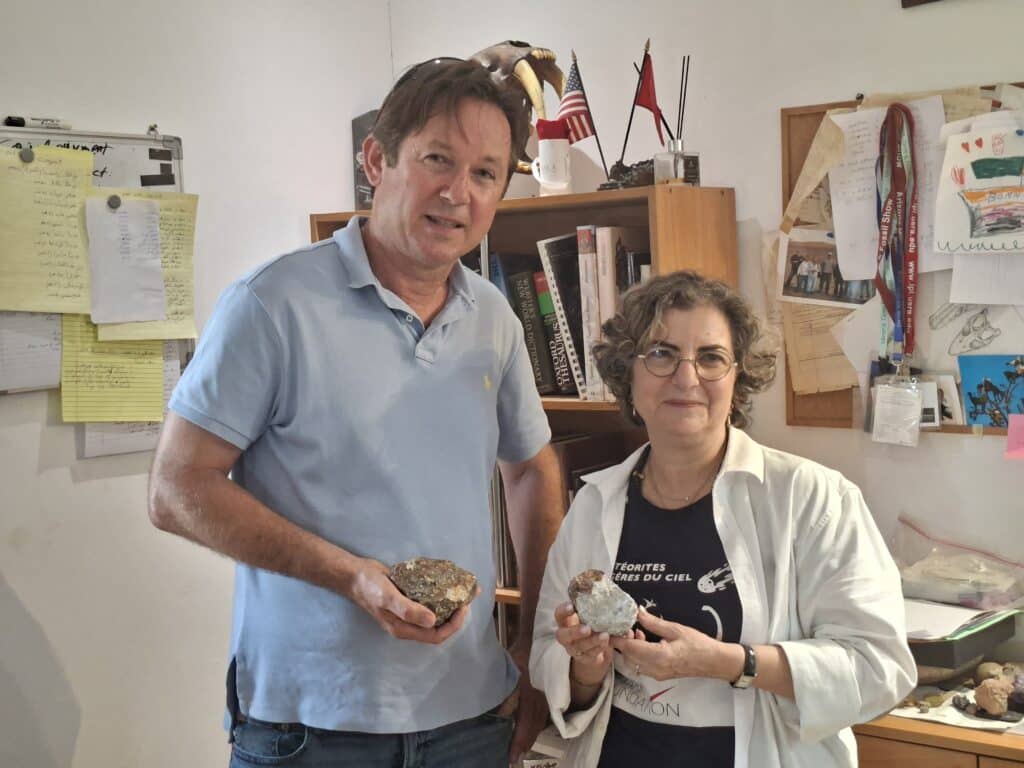
EXCLUSIVE STORY. In the Khémisset-Tiflet region, a meteorite fell on the morning of February 7, 2026. After nearly two years without a similar event, this fall represents a major interest for science and also sparks economic interest for meteorite hunters. Médias24 accompanied Professor Hasnaa Chennaoui Aoudjehane and Adam Aaronson on the field mission regarding this new discovery. Here is what you need to know.
On the morning of Saturday, February 7, 2026, shortly after 10 a.m., a sound of explosion was heard in several rural areas located between Khémisset and Tiflet. Several local witnesses reported hearing one or more loud noises, without immediately understanding their origin.
These rumblings are linked to the unnoticed fall of a meteorite, whose existence was only recently confirmed, after photos of the found sample were widely shared on social media platforms specializing in meteorite hunting.
This is the 28th observed meteorite fall in Morocco, an event that is already generating significant interest within the international scientific community.
For this occasion, Médias24 went to the field with Prof. Hasnaa Chennaoui Aoudjehane, a planetary scientist, professor at the Hassan II University of Casablanca, resident at the Institute of Advanced Studies (UM6P), and president of the ATTARIK Foundation, along with Adam Aaronson, an international expert in meteorite commerce and research.
The account of the first discoverers of the fall
The first witness, who requested anonymity, is the one who found a part of the meteorite. He was tending a flock of sheep when he heard the sound of an explosion in the sky. According to his statements, the meteorite fell right in the middle of his flock, before they scattered at the sight of the fall.
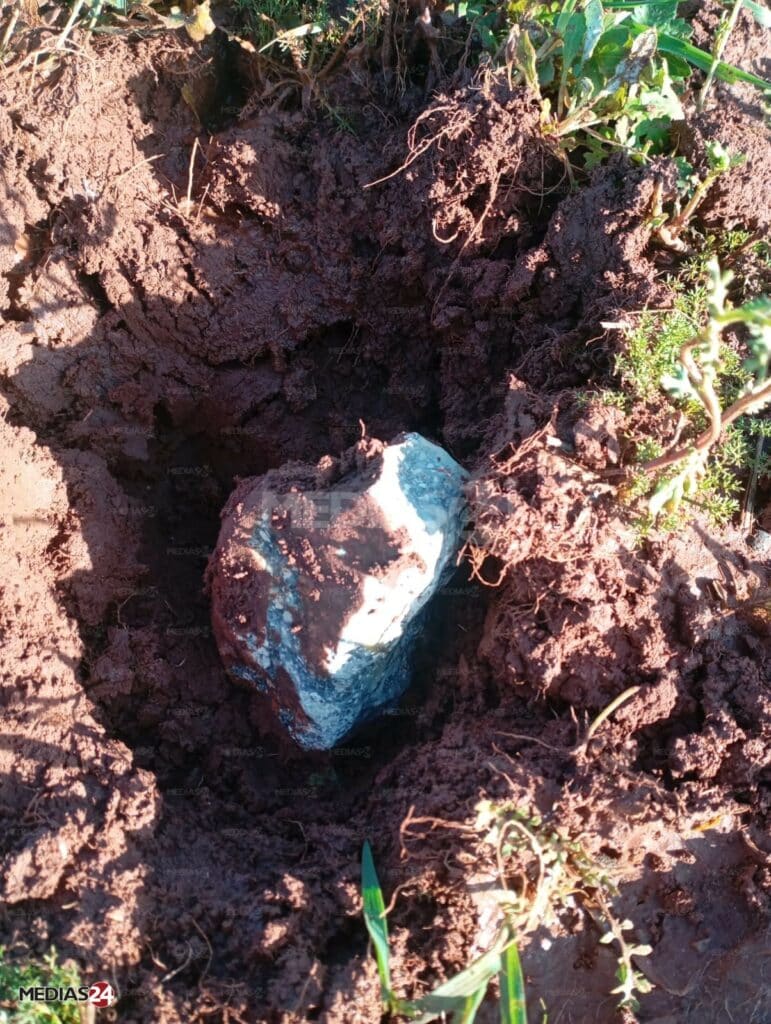
"In all my life, I have never seen anything like this. And you saw that rock, I showed you the photo taken at the moment it fell in front of me... it made a hole," said the witness.
"At that moment, it hadn't even been three minutes since it hit the ground when I photographed it," he added.
"And when I picked it up in my hand, it almost froze it," he pointed out.
On the other hand, a second witness, a shepherd tending a herd of cows only a hundred meters away from the first witness, confirms this testimony, the date, and the location of the incident. He describes the same scenario: the sound of an explosion, then, after a period of time, a fall barely visible to the naked eye.
Other witnesses confirmed hearing a muffled noise, without knowing the origin or location, while others only learned of this event through word of mouth.
For Prof. Chennaoui, the work is just beginning
The first and only Arab expert to have sat on the prestigious Nomenclature Committee of the Meteoritical Society (the body that records all known meteorites), Prof. Hasnaa Chennaoui visited the site of the fall and confirmed the extraterrestrial nature of the find.
"What was reported as a meteorite fall last February has been confirmed: a rock did indeed fall in the Khémisset-Tiflet region. Once this is proven, it becomes essential for me, as an international expert, to go to the field to collect all the information," says Prof. Chennaoui.
This fieldwork is meticulous. "Collecting data, interviewing eyewitnesses, trying to gather as much information and the exact coordinates of the fall... All this information will help us write a report, which is somewhat the family record or birth certificate of this meteorite," she explains.
Now, Prof. Chennaoui is taking charge of studying this new meteorite to classify it and determine its exact origin. However, out of strict scientific rigor, she refrains from publicly confirming the specific type of this celestial object for now.
"As a researcher and expert, I cannot make a statement on that. Yes, I can confirm that it is clearly an achondrite [a meteorite without chondrules, those small mineral spheres typical of primitive meteorites, Editor's note], but I cannot yet say what type it is, even though I have my suspicions," she confides.
This caution is the necessary step before the official announcement of the discovery. "Once we have completed this process, we will make a statement for this observed fall. It will receive a proper description, following the rules of the art, which will give it the recognition it deserves globally, just like all the observed falls that we have had the privilege to classify and declare," concludes Prof. Chennaoui.
Adam Aaronson: an exceptional find, according to initial observations
For his part, Adam Aaronson, an expert and leader of a company specializing in meteorite import-export — authorized by the supervisory ministry —, believes that this is a find of great scientific interest.
"I have indeed acquired a sample, but there is then a rigorous process to follow. First, we need to involve a scientific committee, preferably Moroccan in my case, to assist us in the certification and documentation of the meteorite," explains Mr. Aaronson.
To prove the economic value of the find, Adam first invests in the classification of this meteorite. This process starts with fieldwork involving the collection of testimonies, followed by very detailed geochemical analyses, including oxygen isotope analysis, before being submitted to the Nomenclature Committee of the Meteoritical Society.
Currently, after acquiring the samples and conducting documentation work in the field, geochemical analyses are ongoing.
"In the end, the nomenclature committee decides: either you have covered all the necessary points for classification, or something is still missing. They approve it in a way. And at that point, it is given a name. Generally, it is the name of the nearest village or town where the rock fell. And then it is classified. It is given a name like Tissint, Tirhert, Tarda... these are the names of the nearest village, geographical point. Sometimes it's a hill, a mountain... a side point... it depends," adds our interlocutor.
From the preliminary examination by Adam Aaronson, he also believes it is an achondrite and not an ordinary chondrite, which contain chondrules.
"From what I have observed, it is a very interesting specimen. What I am saying is speculative, but it is speculation based on over twenty years of experience in meteorite commerce," he points out.
"It is undoubtedly an achondrite, I am 100% sure of that. It is not a normal chondrite. Pending the results of the analyses, and based on the visual observation of the samples, I lean towards an Aubrite or an Eucrite. I would say that the probabilities tend 50% towards an Aubrite, 40% towards an Eucrite, and 10% towards an 'ungrouped' meteorite," he explains.
The family of achondrites is as diverse as it is fascinating. The most common are the HED (Howardite, Eucrite, Diogenite), which mostly come from asteroid Vesta. There are also Martian meteorites (like the one fallen in Tissint) or lunar meteorites (none of which have been discovered in Morocco yet).
As for Aubrites, they remain exceptional. To date, the meteorite from Tiglit, fallen in 2020 south of Guelmim, was the only observed fall of this type in Morocco. Interestingly, another meteorite identified as an Aubrite fell very recently in Germany, near Berlin, only a month after the Khémisset-Tiflet event.
Why did it take so long for the Khemisset meteorite to emerge?
Indeed, there is a long delay between the meteorite fall and its discovery by the population. For Adam Aaronson, who discovered the information on March 20, 2026, this delay is entirely normal, due to the absence of people with a connection to meteorites in this region, unlike the southeastern part of Morocco where a large part of the population is constantly engaged in this research activity.
This event highlights the importance of meteorite hunters for Moroccan scientific research and for income-generating economic activities. "Morocco is fortunate to have such an active community; otherwise, many falls would have been ignored and lost forever. We probably have the largest community of meteorite researchers in the world," emphasizes the expert.
In the field, these prospectors collaborate very responsively with researchers. "In the end, it's a win-win situation: from the museum to the collector, through the scientist, everyone benefits. If there wasn't this field community to search for and find the rocks, scientists would have nothing to study," insists Adam Aaronson.
Additionally, what could have also accelerated this discovery is a network of detection cameras. With an investment in a sophisticated camera network, the meteorite would have been found much earlier, allowing for an exact count of how many pieces there could be and in which area to search.
What scientific interest does this observed fall hold?
"Observed falls" refer to meteorites whose passage through the atmosphere was witnessed by eyewitnesses and which are recovered shortly after impact.
This rapid collection is important for scientists. "Working on observed falls is very interesting because it is fresh material, just arrived from space, and has not stayed on Earth to undergo terrestrial alteration," emphasizes Prof. Chennaoui.
The scientific stakes are even higher when dealing with rare specimens. "As was the case with the Tissint meteorite, which is a Martian rock, and only the 5th observed fall of this type in the world. An exceptional discovery, as access to a very fresh rock has provided countless information about the surface of the planet Mars," she recalls.
In Morocco, the first observed fall that benefited from this rigorous approach (fieldwork, classification, and official declaration) is that of the Benguerir meteorite, fallen in broad daylight on November 22, 2004. This event acted as a real catalyst. It not only paved the way for the systematic classification of Moroccan meteorites but also energized a very active local community in the search for these rocks.
Thanks to this synergy between meteorite hunters and scientists, Morocco now stands out as the country that has recorded the largest number of observed falls in the world over the past 25 years.
Recall of Moroccan law on meteorite collection
In Morocco, the collection and commercialization of meteorites are subject to a renewable authorization every five years from the Department of Geology, as specified in Article 116 of Law 33.13 and Decree No. 2-18-968.
Regarding meteorite exportation, it is allowed with a receipt from the Geological Department required by the customs administration (Circular No. 6014/311). In return, the exporter must provide an identification card as well as a sample of the meteorite intended for commercialization or export.
The sample provided to the administration must weigh 20 grams if its total mass is less than 1 kilogram and 40 grams if it is more. Pre-decree consultations concluded that these samples should be given for scientific research purposes to the said Department.
While awaiting the grand project National Museum of Archaeology and Earth Sciences, a large-scale project planned in the capital, Rabat, the observation of all observed falls in Morocco is possible at the expo-museum "Meteorites: Messengers from the Sky, ORIGINS" of the ATTARIK Foundation in Casablanca.

à lire aussi
Article : La politique de l’eau, un enjeu de souveraineté nationale selon Nizar Baraka
Lors du MAP Town Hall organisé à Rabat, le ministre de l’Équipement et de l’Eau a détaillé cinq priorités : dessalement, interconnexions entre bassins, équité territoriale, préservation des ressources et valorisation de l’expertise marocaine à l’international.

Article : Tourisme : pourquoi l’objectif des 26 millions de visiteurs pourrait être atteint avec deux ans d’avance
Le tourisme marocain est en avance sur son propre calendrier. Alors que l’objectif officiel reste fixé à 26 millions de visiteurs en 2030, les performances récentes poussent déjà le secteur à préparer l’étape suivante : une nouvelle feuille de route pouvant viser 30 millions d’arrivées et près de 200 milliards de dirhams de recettes.
Article : Formation continue : le CESE pointe un système trop complexe et trop concentré à Casablanca
En 2022, seuls 1.647 employeurs sur près de 315.000 cotisants ont bénéficié des contrats spéciaux de formation, selon le Conseil, qui recommande un fonds dédié, la digitalisation des démarches et un meilleur accès pour les TPME et les indépendants.
Article : Bourse de Casablanca : le MASI termine en légère baisse le 3 juin 2026
L’indice principal s’est établi à 18.563,40 points, dans un volume d’échanges de 237,9 MDH sur le marché central, avec Managem, TGCC et Alliances parmi les valeurs les plus actives.
Article : La pyrite, vieux résidu minier devenu enjeu stratégique pour OCP
C’est l’histoire d’un minerai longtemps négligé qui revient au centre du jeu industriel. Alors que les prix du soufre atteignent des niveaux historiques, OCP prépare dès 2027 la récupération locale de pyrite et de pyrrhotite, avec Managem et d’autres acteurs miniers en toile de fond. Explications.

Article : Après 17 ans, Lamia El Ghorfi quitte La Mamounia pour se consacrer à un projet familial
Après dix-sept années passées à La Mamounia, Lamia El Ghorfi a annoncé son départ de la Direction de la communication et des projets culturels. Elle indique vouloir se consacrer à un projet familial, tandis que son successeur sera dévoilé dans les prochains jours.