
Royal Theatre of Rabat. A landmark project driven by King Mohammed VI’s vision for the “City of Light”
The inauguration of the Royal Theatre of Rabat on Wednesday, April 22, 2026, forms part of the cultural policy driven by King Mohammed VI to make the capital a major centre of artistic influence. Combining remarkable acoustics, an unprecedented orchestral fusion and a dialogue between repertoires, the event celebrated the richness of a national artistic scene now equipped with a venue worthy of its ambitions.
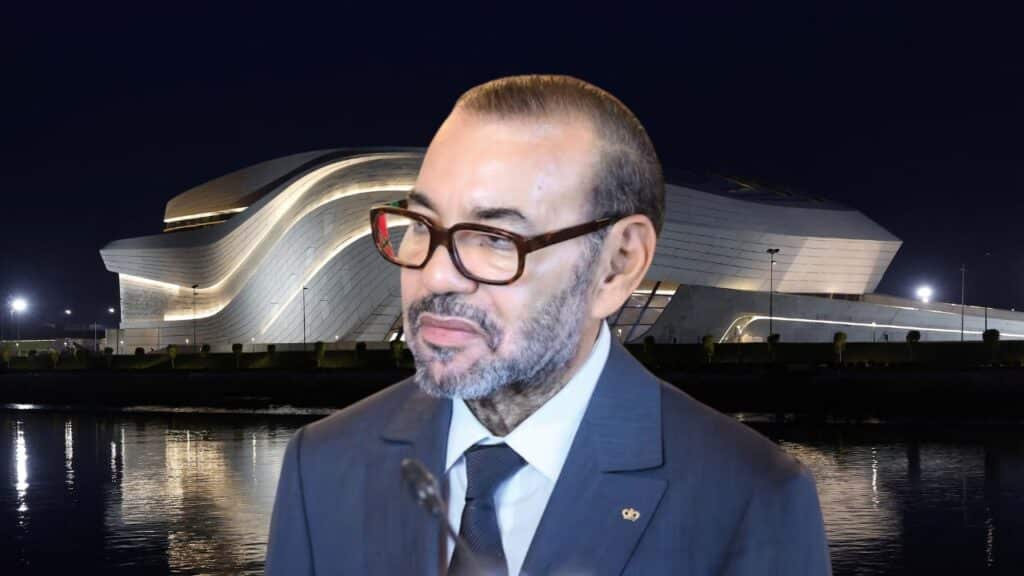
At the heart of the Bouregreg Valley, between Hassan Tower, the Mausoleum of Mohammed V and the new Mohammed VI Tower, now stands the Royal Theatre of Rabat, a flagship project launched under the impetus of King Mohammed VI as part of the “Rabat, City of Light” vision.
Part of a royal strategy aimed at enhancing the Kingdom’s heritage and cultural influence, this iconic building was inaugurated in the presence of Princesses Lalla Khadija, Lalla Meryem and Lalla Hasnaa, as well as France’s First Lady, Brigitte Macron.
Hundreds of creators, intellectuals, performing artists and members of the diplomatic corps attended the event, which underscored culture’s role as a pillar of national development, at the heart of the priorities championed by the Sovereign.
The evening opened with a film highlighting the modernist vision behind this unique architectural project, conceived as a marker of Morocco’s cultural policy. But it was the musical opening that left the strongest impression. For Farid Bensaid, a member of the Theatre Foundation’s board of directors, the performance of the national anthem by a children’s choir and orchestra was a "deeply moving" and symbolically powerful moment.
“Like everyone involved in culture, we are proud,” he told Medias24. As founder of the Moroccan Philharmonic Orchestra (OPM), he described the presence of the princesses and their guest as a major source of encouragement for the entire Moroccan artistic community, in line with the King’s continued commitment to creativity and cultural industries.
A 100% Moroccan stage for a universal repertoire
The performance rose to a significant challenge: presenting an entirely Moroccan lineup (conductor, orchestra, soloists, choirs and children). The evening also marked a historic union between two institutions: the Moroccan Philharmonic Orchestra, celebrating its 30th anniversary, and the Royal Symphonic Orchestra, with 20 years of history, illustrating the growing strength of a national cultural ecosystem supported at the highest level of the State.
Under the direction of conductor and pianist Dina Bensaïd, 76 musicians and 40 choristers combined their talents. The programme brought Morocco’s musical heritage into dialogue with the international repertoire:
- Classical piano by Marouan Benabdallah, performing Tchaikovsky.
- Great operatic arias by Bizet and Verdi, performed by mezzo-soprano Ahlima Mhamdi.
- Arab-Andalusian singing performed by Samira Kadiri.
- The oud of Driss El Maloumi, virtuoso and composer, through a contemporary creation with distinctly Moroccan sonorities.
An acoustic and technical “jewel”
One of the evening’s key takeaways was the technical quality of the venue. Farid Bensaid, himself a violinist, experienced the performance from the auditorium alongside other board members. “It’s a different way of appreciating art when you watch your colleagues perform. It allowed me to hear the orchestra differently,” he explained.
The major revelation was the acoustics: the orchestra played without any amplification. “We have a real jewel,” Mr. Bensaid enthused, adding that even for passages requiring specific amplification, such as the oud, the result remained “very harmonious to the ear.”
The Royal Theatre of Rabat is not limited to classical music. Farid Bensaid highlighted the venue’s versatility, noting its ability to host all art forms. Thanks to its orchestra pit, Morocco will now be able to stage ballets and operas to international standards.
This inauguration marks only the beginning. The institution symbolizes the cultural renewal of the capital and the affirmation of values of intercultural dialogue, promoted through the vision of King Mohammed VI to position Morocco as a regional and international cultural hub. As Mr. Bensaid noted, this new venue will finally provide classical music and other genres with a platform of excellence commensurate with the Kingdom’s global ambitions.

à lire aussi
Article : Le Maroc face au risque d’une inflation alimentaire diffuse et composite
Alors que les instances internationales s'inquiètent d'un nouveau choc systémique mondial lié aux tensions géopolitiques, le Maroc navigue entre une campagne agricole prometteuse et des goulots d'étranglement logistiques nationaux. Si le blé tendre reste sous protection, les filières animale, sucrière et oléagineuse demeurent exposées à une inflation de second rang et à une saturation portuaire qui grignote les marges de manœuvre. Analyse.

Article : Pourquoi le taux d’inflation ne reflète pas toujours le vécu des ménages
Au Maroc, l’inflation ralentit, mais les ménages continuent de ressentir la hausse des prix et la pression sur leur pouvoir d’achat. Cet écart vient surtout d’une lecture incomplète du taux d’inflation, ainsi que de la nature même du panier représentatif utilisé pour mesurer l’évolution des prix.
Article : Intelcia : Karim Bernoussi et ses partenaires reprennent 100% du capital, sortie d’Altice
Le 28 avril, les deux cofondateurs du groupe, Karim Bernoussi et Youssef El Oufir, doivent finaliser le rachat des 65% du capital détenus par le groupe Altice, dont ils n'avaient conservé que 35% lors de l'entrée du partenaire français en 2016. Une opération qui redonne à ce fleuron de l'économie marocaine sa pleine liberté de manœuvre, au moment précis où son secteur est traversé par la déferlante de l'intelligence artificielle. Karim Bernoussi, PDG du groupe, était l'invité du 12/13 de Médias24.
Article : L’Oukaïmeden, station d’hiver et espace culte de transhumance
Alors que l’Oukaïmeden est appelé à devenir une station touristique quatre saisons à l’horizon 2027, l’anthropologue Mohamed Mahdi rappelle que ce territoire ne peut être réduit à un site de loisirs. Agdal pastoral, espace de transhumance, réservoir de biodiversité et patrimoine culturel amazigh, l’Oukaïmeden impose une approche de développement intégrée, capable de concilier tourisme, pastoralisme et préservation des équilibres sociaux et écologiques.

Article : La météo pour le lundi 27 avril 2026
Voici les prévisions météorologiques pour le lundi 27 avril 2026, établies par la Direction générale de la météorologie.
Article : Plan d’aménagement de Marchica : un nouveau souffle socio-économique pour Nador et Beni Ensar
L'aménagement de la lagune de Marchica s’apprête à un nouveau chapitre. Au-delà des avancées de la première phase, il dessine une nouvelle transformation urbaine et touristique d'ampleur, de Nador à Beni Ensar, jusqu'au village d'Arkman. L’enquête publique s’est achevée vendredi.