
Jewish prayers by Marrakech’s ramparts: behind the controversy, a familiar practice
Filmed on April 21 near Bab Doukkala, the viral footage shows members of the Satmar Hasidic movement, from New York, making a brief 24- to 48-hour stop to pray at the tombs of local religious figures. According to Marrakech’s Jewish community, these occasional visits, unrelated to the site itself, are part of regular pilgrimage routes.
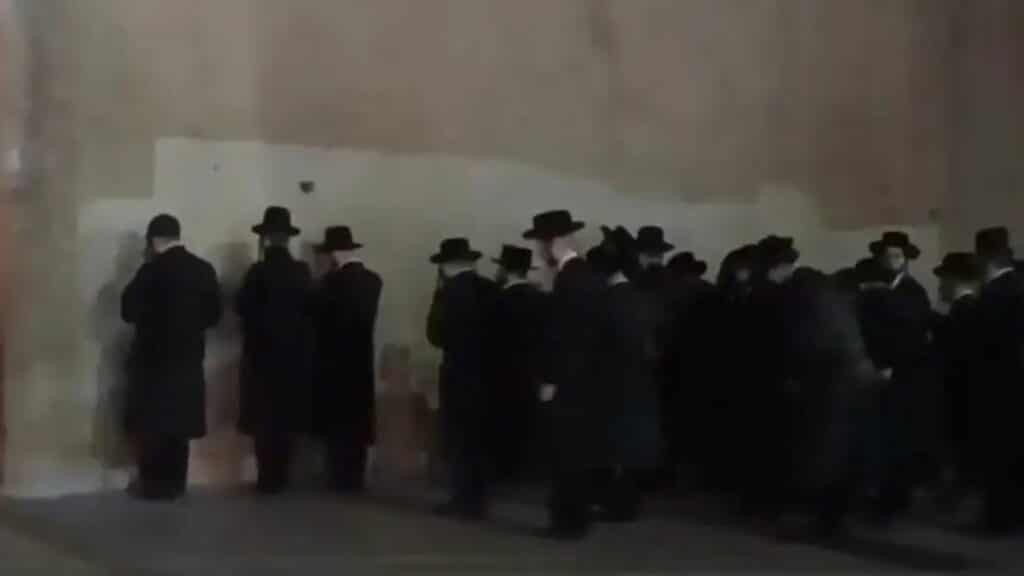
The viral spread, since Tuesday, April 21, 2026, of videos showing Jewish worshippers performing religious rituals outdoors near the historic Bab Doukkala site in Marrakech has sparked a heated debate on social media.
The footage, showing what look like Jewish prayers against the city’s ancient ramparts, has prompted widespread discussion online and among civil society groups, with some questioning the nature and apparent novelty of the scene.
مواطنون مغاربة يستغربون من ظهور مجموعة من اليهود بلباس المتشددين وهم يتبركون من حائط في مدخل منطقة باب دكالة بمراكش 🇲🇦 pic.twitter.com/j3Er3QP9F4
— الرادع المغربي 🇲🇦🔻🇵🇸 (@Rd_fas1) April 21, 2026
For representatives of the local Jewish community, however, the reaction amounts to a "storm in a teacup". Jacky Kadoch, president of the Jewish community in the Marrakech-Safi region, told Médias24 that there is little point in debating an event that is neither new nor provocative.
The identity of these pilgrims is well known. They belong to the Satmar Hasidic community, an Orthodox movement based in New York, particularly in the neighborhoods of Williamsburg and Monsey. Although not of Moroccan origin, these worshippers maintain a deep devotion to the Kingdom’s Tsadikim (saints).
According to Mr. Kadoch, their presence does not follow conventional tourism patterns. They undertake so-called "go and back" pilgrimages — short stays of 24 to 48 hours dedicated exclusively to prayer at the tombs of major Kabbalistic figures such as Rabbi Abraham Azoulay, Rabbi Hanania Ha-Cohen or Rabbi David Hazzan.
As for the choice of the Bab Doukkala wall, the explanation is purely practical. Worshippers are simply looking for a neutral surface for prayer, away from the distractions of the urban environment. "The rampart holds no intrinsic religious significance for them," Mr. Kadoch explained.
Morocco, a "land of peace" for the Hasidim
The attachment of this community to Morocco is longstanding. An anecdote shared by Jacky Kadoch illustrates this connection: about eight years ago, emissaries of the community’s Grand Rabbi requested a feasibility study for a "spiritual village" near the coast. Their spiritual leader described Morocco as "a holy land and a land of peace, protected by an extraordinary King".
Although the project did not materialize following the refusal of local authorities on security grounds, the integration of these worshippers is already a tangible reality. In Touama, 40 kilometers from Marrakech, as well as in certain mountainous areas, members of this community have lived peacefully and in harmony with local populations for many years.
Beyond the reactions sparked online, the episode highlights the singular character of Marrakech, a crossroads city where centuries-old coexistence is inscribed in its stones. By remaining a destination for pilgrims from around the world, Morocco reaffirms its identity as a land of encounter and tolerance.
In the face of the immediacy of viral images, the city answers with the depth of its history, showing that spirituality, when practiced with respect for places and people, remains one of the enduring pillars of Morocco’s unique identity.

à lire aussi

Article : Météo: les prévisions du dimanche 25 avril 2026
Voici les prévisions météorologiques pour le dimanche 26 avril 2026, établies par la Direction générale de la météorologie : - Formations brumeuses matinales et nocturnes […]
Article : Sahara: De Mistura évoque un “véritable élan” qui relance l’espoir d’une issue au conflit
Comme prévu par la résolution 2797 adoptée le 31 octobre 2025, le conseil de sécurité de l'ONY s'est réuni à huis clos pour faire le point avec l'envoyé personnel et l'envoyé spécial de l'ONU pour le Sahara, au sujet de l'avancement des efforts de paix.

Article : Immobilier. Les nouveaux choix d'investissement en 2026 à Casablanca
À Casablanca, le marché immobilier change de configuration. La raréfaction des petites surfaces et la hausse des prix pèsent sur le résidentiel, tandis que des segments comme la logistique et l'industriel offrent aujourd'hui des rendements plus élevés. Dans ce contexte, les arbitrages des investisseurs évoluent selon les budgets et les opportunités. Décryptage avec Asaad Sadqi, président de l'Association régionale des agences immobilières Casablanca-Settat.
Article : Un milliard sans garantie de l'État : comment la région Casablanca-Settat a réussi son pari obligataire
La région Casablanca-Settat vient de clôturer sa première levée obligataire, une opération inédite pour une région. La levée est d'un montant d'un milliard de dirhams sur le marché des capitaux, dont 400 millions apportés par la Banque mondiale (BERD). Le président de la région, Abdellatif Maazouz, revient sur les coulisses de cette opération, ses fondements financiers et les projets qu'elle est appelée à financer.

Article : Carreaux céramiques : ouverture d'une enquête antidumping sur les importations indiennes
Le Maroc ouvre une enquête antidumping sur les importations de carreaux céramiques en provenance d’Inde. À l’origine de cette procédure, les industriels marocains du secteur dénoncent des pratiques de dumping et une hausse soutenue des importations indiennes, jugées menaçantes pour la production nationale.
Article : African Lion 2026 : une édition placée sous le signe de l’innovation technologique et de la maturité stratégique
L’édition 2026 de l’exercice militaire African Lion, le plus grand rassemblement de forces armées sur le continent, se déroule du 20 avril au 8 mai. Entre l’utilisation de nouvelles technologies de pointe et une intégration accrue entre les forces marocaines et américaines, cette cuvée marque un tournant qualitatif, malgré une certaine discrétion médiatique dictée par le contexte international.