
Arbitration. How Casablanca is seeking to establish itself as an African hub in the shadow of Paris and London
On the occasion of its tenth anniversary, Médias24 interviewed the heads of the Casablanca International Mediation and Arbitration Center about its track record and ambitions. Beyond the technical nature of arbitration clauses lies a very concrete challenge: convincing companies and investors that their disputes can be settled in Morocco, with the same safeguards offered by major international hubs. Interview.
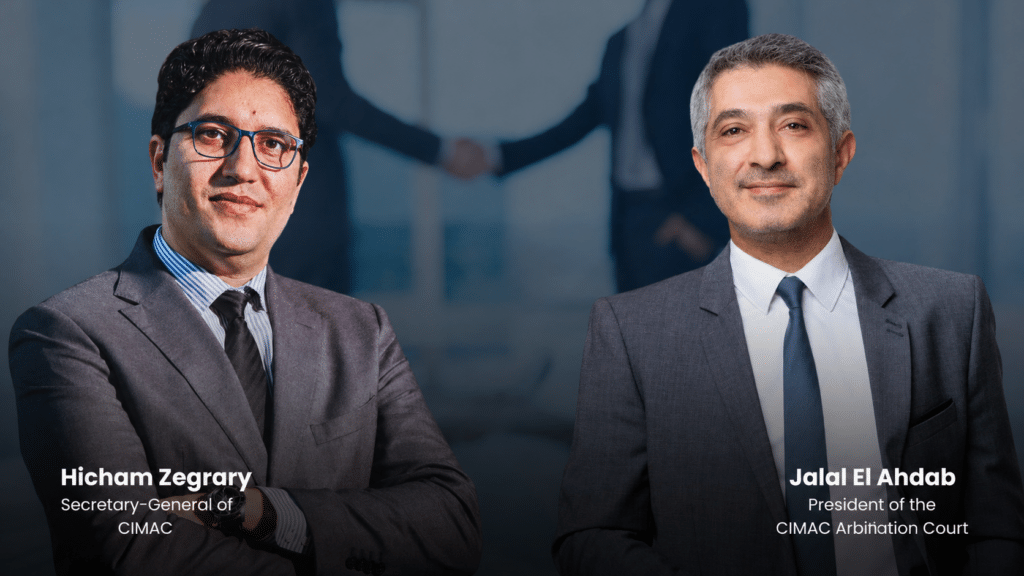
Ten years of institution-building, several international contracts governed by its rules, and no annulment proceedings. This is the milestone marked by the Casablanca International Mediation and Arbitration Center (CIMAC) during the Casablanca Arbitration Days, held on April 24 and 25, 2026, in Casablanca.
On the sidelines of the event, Médias24 spoke with Hicham Zegrary, Secretary-General of CIMAC, and Jalal El Ahdab, President of the Center’s Court. They looked back on CIMAC’s first ten years, its creation and development, as well as the relevance of arbitration for Africa. They also explained how arbitration can serve as a lever of competitiveness, both for countries and for economic actors.
10 years of existence
- Médias24: CIMAC is celebrating its 10th anniversary this year. How has it evolved since its creation in 2016?
- Hicham Zegrary, Secretary-General of CIMAC: Legally, CIMAC was established in March 2016. However, the initial groundwork dates back to 2010. Its creation is part of the broader momentum initiated by Casablanca Finance City (CFC). The objective was to equip Morocco with an international dispute resolution center, complementing the state court system. While local structures already existed, there was a lack of an internationally oriented mechanism capable of meeting the specific needs of financial market participants.
It took six years to prepare the creation of the Center and bring it to launch. We had to bring together key national and international stakeholders, as well as world-renowned arbitrators willing to join us in order to build credibility.
Although Morocco already had strong domestic expertise, companies operating within the Casablanca Finance City ecosystem—most of them foreign—needed an international center where arbitration, and particularly the arbitration court, reflects what they are used to in major global arbitration hubs such as New York, London, Paris, Dubai, Hong Kong or Singapore.
CIMAC’s first cases began to emerge in 2021, following the Covid crisis
The creation of the Center was therefore preceded by extensive preparatory work. The same applies to the drafting of the arbitration rules, which took the entire year of 2016. While arbitration frameworks exist worldwide, it was necessary to benchmark best practices, select those most relevant, and adapt them to the Moroccan context.
Our rules entered into force on January 1, 2017, from which point awareness efforts were launched—first targeting actors within CFC, then extending nationally before reaching an international scope. The aim was to introduce CIMAC, its objectives, as well as its court and arbitration rules.
Another key challenge was to build trust by encouraging operators to include arbitration clauses in their contracts as an alternative to state courts. This long-term effort began to yield results from 2021, with the arrival of the first cases at the Center, in the context of the post-Covid recovery.
At the national level, arbitration centers already existed, but we are the only one to have been established with this configuration, similar to only four or five others across Africa.
Gender parity, international diversity and highly qualified profiles across legal systems
CIMAC also stands out for the international diversity of its members—men and women from Africa, notably Morocco, Nigeria and Mali, as well as from Europe and the Americas. Another notable feature is the Center’s effective gender parity, still rare in such institutions, making it a pioneer in this regard.
The Center also benefits from a pool of highly qualified professionals involved in both commercial and investment arbitration. These experts come from different legal systems—OHADA law, civil law and common law—and possess strong expertise in European legal environments. Most are multilingual, which represents a major asset for CIMAC. This diversity and expertise have sustained the trust placed in the Center over the past ten years.
- Jalal El Ahdab, President of the CIMAC Arbitration Court: At the outset, as in Corneille’s Le Cid, “we set out” as a small group—but with strong conviction. Morocco is a crossroads between East and West, the Mediterranean and the Atlantic, Africa and the Arab world. There was a powerful narrative to build, one from which the Kingdom had to benefit. This is precisely the logic of arbitration: being at the intersection of multiple legal cultures and economic systems.
There was also a clear opportunity from both a geographical and market perspective. A place had to be claimed within the regional arbitration landscape, especially given that arbitration has long been part of Morocco’s legal culture.
It should be recalled that Morocco was among the earliest users of ICSID (International Centre for Settlement of Investment Disputes) arbitration, and that ad hoc arbitration—i.e. non-institutional arbitration—has always been widely practiced. The objective was therefore to give institutional arbitration a concrete presence.
Regarding the regulatory framework, we worked extensively from 2013 to develop modern arbitration rules capable of properly structuring proceedings and aligning CIMAC with the standards of leading institutions (ICC, LCIA, AAA, HKIA…). This need for adaptation remains relevant today, as we have recently launched the preparation of new rules, with the original framework approaching its tenth anniversary.
The Center is primarily positioned as a regional hub
Moreover, beyond all these specific features, it should be noted that the Center enjoys the trust of public authorities. The arbitration law enacted in 2022 expressly states that the legislator consulted several stakeholders, including CIMAC.
The Center has therefore contributed to shaping a more favorable legislative framework, which represents a strong signal of recognition and responsibility. At the same time, ongoing dialogue with the judiciary to promote the use of ADR (Alternative Dispute Resolution) mechanisms—as well as engagement with key institutions such as the Competition Authority, the Kingdom’s Judicial Agency and the CGEM—remains a priority, contributing to the gradual integration of CIMAC into Morocco’s legal landscape.
- The name “International Mediation and Arbitration Center” may suggest that it is only intended for large companies. Is that really the case?
- Jalal El Ahdab: The term “international” is important because, indeed, whenever a dispute involves a Moroccan party and a non-Moroccan party, it becomes international. The term reflects the idea that the Center’s location in Casablanca does not compromise its neutrality. That is the essence of an international arbitration center. However, the Center is first and foremost positioned at the national and regional level, serving as a bridge between Africa and Europe, and more broadly for disputes across the continent.
The ambition is to host disputes between foreign parties, particularly African ones, without necessarily any connection to Morocco. The goal is to position Casablanca—and more broadly the Kingdom—as a neutral, credible and secure jurisdiction capable of handling such disputes and ensuring their enforcement without interference from state courts. Achieving this will require the support of Moroccan assisting judges, national and regional authorities, and a strong community of practitioners.
Hicham Zegrary: We included the term “international” to differentiate ourselves, as we have an international court and rules inspired by leading global practices, while remaining fully accessible to national actors, SMEs and even micro-enterprises.
We have designed rules that take into account their specific needs, with a very competitive fee schedule compared to international standards, while ensuring equivalent quality.
- You mentioned the evolution of the regulatory framework introduced in 2022, following the King’s call to promote alternative dispute resolution mechanisms. Can we speak of a real acceleration from 2023 in Morocco? And what concrete impact has this law had on the ground?
- Jalal El Ahdab: It is in this context that CIMAC was consulted. There was a previous draft law, following the 2008 framework, around the mid-2010s, which did not fully reflect Morocco’s potential. Fortunately, our proposals were taken into account, resulting in a compromise text that is more flexible and more favorable to arbitration.
Let me give a few examples. Under the 2008 regime, inspired in particular by French and Swiss law, it was possible to obtain recognition of an arbitral award on an ex parte basis. In practice, this meant that there was no need to summon the opposing party or initiate adversarial proceedings. The request could be submitted through a simple application, allowing for rapid recognition. The underlying idea was that an arbitral award, being already a decision, did not require fresh proceedings on the merits to become effective. However, Moroccan courts chose not to apply this provision in practice.
As a result, it remained largely ineffective. In 2022, adjustments were made so that legal provisions align more closely with judicial practice. Recognition of awards now requires formal proceedings initiated by summons rather than a simple application.
Furthermore, several changes were introduced to strengthen the role of judges in assisting with the constitution of arbitral tribunals and to relax certain procedural constraints. The aim was also to allow for greater flexibility, particularly in ad hoc arbitration, as the law is not intended to regulate procedures governed by institutional rules. At the same time, even before the reform, courts had already shown a generally favorable approach in matters of recognition and annulment.
Morocco is also among the few jurisdictions in the Arab world to have extended arbitration clauses to non-signatories, although recent case law has somewhat limited this extension. Overall, jurisprudence has contributed to creating a favorable legal environment for arbitration.
- Hicham Zegrary: The reform is relevant. However, it does not fully reflect everything we had advocated for.
It draws heavily on the UNCITRAL model law, which is a global reference in arbitration legislation.
Moreover, His Majesty King Mohammed VI had long been a precursor in this area. In numerous speeches and royal messages—particularly at investment forums—he consistently emphasized legal security, the business environment and investment attractiveness as key priorities. Through these interventions, he called on public authorities to implement reforms, which materialized in 2022, and encouraged both public and private actors to make greater use of mediation, arbitration and conciliation—that is, alternative dispute resolution mechanisms more broadly.
Barriers still present in practice
- You have not achieved 100% of what you initially sought in terms of regulation. Does this mean that constraints still persist in the practical application of the law or arbitration in Morocco?
- Hicham Zegrary: Take the example of arbitral awards. It is not necessary to obtain exequatur—i.e. recognition by a state court—for them to be applicable. We would like the law to be more liberal on this point.
The law has also introduced mechanisms to limit abusive challenges, particularly in annulment proceedings. When a party that has lost an arbitration files a claim deemed dilatory or unfounded, a significant financial penalty may be imposed. This mechanism was introduced to strengthen legal certainty and deter procedural abuse. Our ambition is to go even further toward a more liberal framework that actively promotes mediation and arbitration. Significant progress has already been made, and we intend to build on this momentum.
Moreover, legal reform is, by nature, adaptable. I believe that senior officials within the Ministry of Justice are open to further improvements. We should therefore be able to revisit the 2022 law at the appropriate time.
- Jalal El Ahdab : A legislative framework is not meant to remain static. It evolves. In the next phase—within five to ten years—we hope to see further progress on these issues.
Out of 54 African countries, only four or five arbitration centers meet the required standards
There are, for instance, two areas that are not major issues but could still be improved. The law still requires that arbitral awards be filed with the court registry once issued. This requirement exists in certain jurisdictions, such as Qatar or Saudi Arabia, but remains relatively rare. It is largely a legacy of older legal systems that sought to maintain control over judicial outcomes.
We believe this requirement is unnecessary and may actually slow down the process, particularly as awards often need to be filed in Arabic.
In some cases, these awards run to 300 pages, requiring extensive translation work. This represents both a loss of time and additional costs.
Similarly, the 2022 law retained the requirement for a list of arbitrators, even though it is not strictly necessary. While such lists may reassure some users, they also have drawbacks. The essence of arbitration is flexibility and independence from the constraints of the judicial system. Aside from a few such points, the reform represents real progress, and this trajectory should be maintained.
- Can we say that Casablanca has now established itself as an arbitration hub in Africa?
- Hicham Zegrary: I believe so. The continent is vast, but today there are only a few key centers: Cairo, which mainly serves Egypt and the Arab world, as well as Dubai, Abu Dhabi and Qatar; Kigali in Rwanda; Nigeria; and CIMAC. Out of 54 African countries, only four or five centers truly meet the necessary standards.
To remain objective, several indicators support this positioning. CIMAC was selected by the Millennium Challenge Corporation (MCC) under the Compact II program, through which Morocco benefited from $500 million. The U.S. federal government designated the Center as the arbitration body for disputes related to this program, including challenges to public procurement procedures. Several cases have already been handled in this context.
We have also been a partner of ICSID since 2018, as well as of VIAC [Vienna International Arbitral Centre]. In addition, we maintain close relations with the Hamburg Chamber of Commerce, which has identified CIMAC—alongside centers in Rwanda, Kenya, South Africa, Nigeria and Egypt—as among the only arbitration centers in Africa recommended to German investors as alternatives to European venues. This initiative, launched in November 2025, is a strong signal of credibility.
- I would like to return to the issue of international users’ trust. How can CIMAC enhance the attractiveness of arbitration in the region, and what levers can be used to strengthen confidence in African arbitration centers?
- Jalal El Ahdab: We have entered into cooperation agreements with several major arbitration institutions, including ICSID in Washington and VIAC in Vienna, as well as with African counterparts. More recently, an agreement was signed with SIDRA in Singapore to develop mediation training programs. This institutional network helps reinforce CIMAC’s credibility and fosters trust among economic actors.
Confidence also stems from training. The more high-level training opportunities we can provide—particularly when delivered by leading figures in the field—the more trust we generate within the market.
When participants attend arbitration conferences, they often do so for academic or professional reasons, but also because, in Morocco’s case, they are attracted by the opportunity to discover the country as a destination.
The Paris Arbitration Week, held annually in Paris, brings together dozens—even hundreds—of conferences over the course of a week, hosted in law firms, hotels and conference venues. This is not only because Paris is a major arbitration hub, with numerous law firms and institutions such as the ICC, but also because it is Paris. People enjoy spending time there. Our ambition is to create a similar dynamic in Casablanca, particularly for African arbitration practitioners and users.
- We understand that some agreements between Moroccan partners still include dispute resolution clauses referring to foreign arbitration centers such as Paris or London. How do you explain this, and should measures be introduced to address it?
- Hicham Zegrary: Arbitration is based on freedom of choice. Economic actors remain free to select the center they consider most appropriate.
For disputes below €200,000, the procedure is accelerated and can be completed in less than six months
This is indeed a reality, particularly among large Moroccan groups, which still tend to favor international arbitration centers. CIMAC was created, among other reasons, to respond to this demand. We explain to these actors that, rather than systematically turning abroad, they can rely on an international center based in Casablanca offering the same level of quality and rigor—at more competitive costs. Arbitration does come at a cost.
From the outset, one of our priorities has been to raise awareness among Moroccan companies, as well as foreign operators established in Morocco and African partners, encouraging them to choose Casablanca. The objective is to offer a credible and equivalent alternative to international venues and to break the reflex of systematically resorting to foreign jurisdictions.
Admittedly, Casablanca is not yet on par with Paris in terms of international attractiveness, but it now has significant assets at the continental level.
- You mention competitive costs. Can you give us an idea of arbitration costs at CIMAC?
- Hicham Zegrary: We rely on international benchmarks while adapting to the needs of SMEs and micro-enterprises.
For disputes up to 400,000 dirhams (approximately €40,000), registration and case management fees amount to 20,000 dirhams (around €2,000). For disputes up to 2 million dirhams (approximately €200,000), which already involve a significant share of the SME sector, costs remain controlled and reasonable. Administrative fees are around 30,000 dirhams, while arbitrators’ fees can reach a maximum of 50,000 dirhams, plus 7.5% of the amount in dispute.
Beyond costs, one of the system’s key advantages is speed. For disputes below €200,000, proceedings are accelerated and can be completed in less than six months. The arbitral tribunal has a six-month deadline to issue its award, under the supervision of the Court and its secretariat.
By comparison, proceedings before state courts remain significantly longer. Despite ongoing reforms, a case may take between six months and one year at first instance, followed by six months to two years on appeal, and potentially an additional one to two years before the Court of Cassation. Overall, litigation may last between six and eight years.
Finally, total costs before state courts can also be substantial, including lawyers’ fees, procedural costs, judicial taxes, expert fees, and, above all, the time involved.
- How many cases has CIMAC handled to date?
- Jalal El Ahdab: We do not yet publish detailed statistics, mainly due to confidentiality constraints. However, we can say that the cases handled involve increasingly significant amounts and continue to grow.
Producing anonymized statistics requires time and a sufficiently large dataset to ensure relevance.
However, we know that CIMAC clauses have been included in hundreds of contracts, representing total assets worth several billion dirhams.
We have handled 15 arbitration cases to date, and none of the awards has been annulled
- Does CIMAC promote mediation to the same extent as arbitration?
- Hicham Zegrary: We initially focused on arbitration, as it is more complex to set up—requiring the establishment of a court, the drafting of rules, and convincing economic actors to use it. As you know, arbitration leads to a final decision. While it may be subject to annulment proceedings, these are strictly limited by law.
However, we also have a mediation framework, implemented through a dedicated commission of mediators. Last year (2025), we handled two mediation cases, and a third is expected shortly. Mediation is increasingly sought after by economic partners because the outcomes are not binding in the same way as arbitral awards. This is why, through our recent agreement with SIDRA, we aim to further develop our mediation training offering.
Parties may first resort to mediation to attempt an amicable settlement, with the support of a mediator. If no agreement is reached, they remain free to proceed to arbitration or to turn to the courts.
- Does CIMAC have a mechanism to monitor the enforcement of its awards in order to assess how they are received by state courts?
- Hicham Zegrary: That is an excellent question. To date, none of the awards rendered under CIMAC and submitted to the courts for enforcement has been annulled. We have also observed, with satisfaction, that in most cases, parties voluntarily comply with the awards, without the need to seek enforcement through state courts.
This can be explained by several factors: the expertise of the arbitrators serving on our panels, the quality of the awards rendered, the strict application of our rules by the CIMAC secretariat, and, to some extent, the confidence that judges place in the Center.

à lire aussi

Article : Tourisme. Lecture de la trajectoire d’un secteur devenu clé (2008-2025)
Porté par la reprise post-Covid, le tourisme marocain a retrouvé puis dépassé ses niveaux d’avant-crise. Mais une lecture de long terme montre une trajectoire plus contrastée, marquée par le choc de 2008 suivi d’une phase d’expansion modérée, puis un changement d’échelle à partir de 2022.

Article : Usines, ports, hôpitaux… comment la 5G privée va transformer le Maroc
Robots pilotés à distance, usines capables de remonter leurs données en temps réel, ports plus fluides, mines plus sûres, stades connectés pour des dizaines de milliers de spectateurs… Au Maroc, la 5G privée n’est plus un concept théorique. Dans une interview à Médias24, Ouassim El Arroussi, directeur des études et du développement chez Inwi, raconte les coulisses du premier déploiement industriel de cette technologie et explique pourquoi il pourrait ouvrir un nouveau marché stratégique pour le Royaume. Plongée.
Article : Sécurité numérique : la NARSA dénonce un site usurpant ses services en ligne
L’Agence nationale de la sécurité routière (NARSA) a mis en garde, le lundi 27 avril 2026, contre un site internet frauduleux usurpant son identité et visant à tromper les usagers.

Article : Cap Holding-Forafric. Ce que rachète Chakib Alj et ce qui reste dans le groupe
Le deal entre Cap Holding et Forafric Global porte sur un périmètre industriel marocain incluant moulins, marques et transformation, sans concerner la holding cotée. Cette dernière conserve un périmètre large et annonce une orientation stratégique vers la défense, la sécurité alimentaire et l'énergie.
Article : Sbata : lancement d’un bassin souterrain de 37.000 m³ pour lutter contre les inondations
La société régionale multiservices Casablanca-Settat a lancé, le lundi 27 avril 2026, un projet d’infrastructure visant à renforcer le réseau d’assainissement des eaux pluviales dans le quartier de Sbata, afin de limiter les risques d’inondation lors d’épisodes de fortes pluies.
Article : Syrie : les autorités démentent l’imposition d’un “kafil” aux ressortissants du Maghreb
L’administration syrienne de l’immigration et des passeports a démenti, le lundi 27 avril 2026, les informations faisant état de l’instauration d’un système de “kafil” pour les ressortissants des pays du Maghreb souhaitant entrer en Syrie.