
Tribute. Abdelwahab Doukkali, the messenger, has fallen silent
The greatest singer Morocco ever gave the Arab world died this Friday, May 8, 2026, in Casablanca. He was 85, with a voice for the ages and a life that read like a novel.
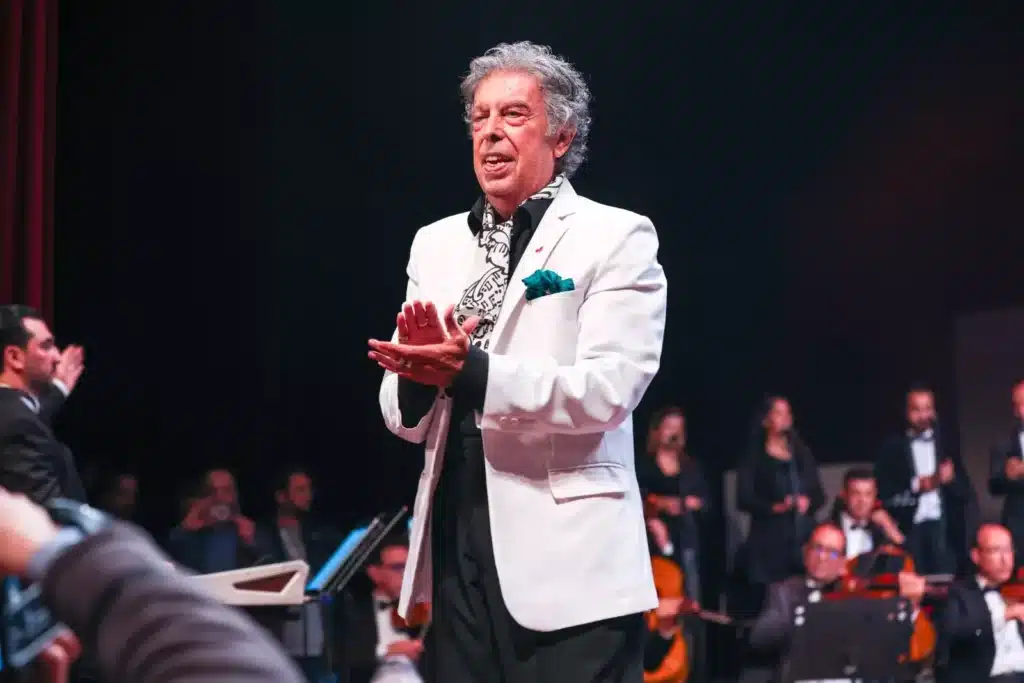
There are voices that never truly die. They slip into the walls of houses, into the warm air of summer evenings we can no longer quite place in time. Abdelwahab Doukkali’s voice was one of them: warm, deep, inhabited by a tenderness that broke something deep inside the chest. This Friday morning, he entered a clinic in Casablanca for surgery… He did not come out. He was 85. Morocco, the Arab world and all those who once closed their eyes while listening to Marsoul el Hob know what they have just lost.
Fez, the cradle of a rebel
He was born on January 2, 1941, in Fez, into a conservative and pious family of thirteen children. His father ruled over them all with an iron fist. In this house where silence was a discipline, young Abdelwahab overflowed: he drew, sang and acted out scenes in the corners of the medina. He attended Moulay Idriss School out of fear of his father’s wrath, and did reasonably well there… But the real school was the street: the voices drifting out of houses at night, the melodies slipping in through open windows. Fez, the conservative city, was too narrow for him. He felt it in his bones.
So, one morning in 1959, he packed his bag and left.
Rabat, boredom and the helping hand
At eighteen, Abdelwahab Doukkali arrived in Rabat and found a job at Moroccan Radio and Television (RTM). Boredom quickly gnawed at him. He was not made for paperwork. He escaped it through song, singing all day long. This did not sit well with Ahmed Al Bidaoui, his boss, who reprimanded him for the slightest thing… Their working relationship was stormy.
But a hand reached out. Mahdi Elmandjra, director of RTM, took a liking to this promising young man and encouraged him to follow the path for which he seemed so clearly destined. Perhaps it was the first time an adult had taken him seriously. He never forgot it.
From Rabat, he headed to Casablanca. His personality, deemed too exuberant, and his audacity, bordering on insolence, closed many doors to him. But a certain Ahmed Taïeb El Alj wrote the lyrics of a song for him that would become a classic: Ya lghadi ftomobil. The wave had begun, and it would not stop.
The “new wave” that shook everything up
This boy from Fez arrived on Moroccan stages like a gust of fresh air in a room that had been closed for too long. Until then, it had been understood that one stood politely on stage and bowed deeply. Doukkali shattered that certainty: he attacked his lute, acted out his lyrics, lived them, closed his eyes to sink deeper into them. From the first note to the last, he was in full performance.
Purists were offended, and the press tore him apart: they mocked his unruly lock of hair, his watch worn on the right wrist — a trend he launched himself — and his jewelry. His audience was described as “lovelorn young girls”. But that very audience filled the halls, learned his songs by heart, hummed them in hammams and kitchens. Habibati, La Tatroukini, Anti: the hits kept coming. The scandals only increased his fame.
Cairo, seven decisive years
In 1962, he decided to leave everything behind. Off to Cairo, to give his career new momentum. The Egyptian capital of the 1960s was the nerve center of the Arab world: Oum Kalthoum reigned there, Abdel Halim Hafez made the walls tremble, Fairuz passed through like a shooting star. It was in that galaxy that Doukkali chose to measure himself.
He quickly made a place for himself on the Egyptian scene and befriended his neighbor, the composer Baligh Hamdi. But the competition was fierce: Abdel Halim Hafez saw him as a rival. No matter… Doukkali absorbed everything: Egyptian maqams, sumptuous orchestrations, the depth of a millennia-old repertoire, and made it uniquely his own. Seven years would pass before his return to Morocco. He came back grown, transformed, confident.
The return and the golden age
Morocco found a changed man. Broader, more assured, more commanding. He returned with a song dedicated to King Hassan II, Habib Ljamahir. Crowds welcomed him as one welcomes someone already known to be immense, but whom one still wants to hear confirm it.
Then came the age of masterpieces: Marsoul el Hob, the messenger of love, which clung to him like a well-earned nickname. Kan ya makan, that musical tale in which one never quite knows whether it is a love story or a story of time. Souk el Bacharia. Lil o Njoum. El-leil We Ana We Enta. And above all, Ma Ana Illa Bachar, “I am only human”, covered by around fifty artists across the Arab world, including the Lebanese singer Sabah, whom King Hassan II himself had asked to record a version during a visit to Morocco.
A song covered fifty times: that is the measure of a man.
Scandals, rivals, loves
Doukkali was never a quiet artist. He had a weakness for celebrities: the Lebanese Sabah, the Egyptian actress Nadia Lotfi. The press spun stories, invented details, spread rumors to topple the statue his fans were building for him. Neither sarcasm nor the enduring rivalry with Abdelhadi Belkhayat could break his stride. He moved forward, head held high, eyes closed, lost in his songs, as always.
A complete artist
What is less well known is that Doukkali was far more than a voice. He composed several film soundtracks, including that of À la recherche du mari de ma femme, and acted in several feature films, including Al Hayat kifah and Rimal min dahab. He was also a painter, with the conviction of a craftsman. He showed his paintings and collections during guided tours of his “Little Museum”, nestled in his apartment on the 17th floor of the Liberté building, in the heart of Casablanca. A man who lived among his works, above the city that had made him.
Honors, from Mohammedia to the Vatican
Awards came from everywhere, and for decades. The gold record for Ma Ana Illa Bachar, the Grand Prize at the Mohammedia Festival in 1985 for Kan ya makan, the Marrakech Prize in 1993, then the Grand Prize at the Cairo Festival in 1997. In 1991, the magazine Al Majalla named him the finest personality in the Arab world following a poll.
In 2001, the title of Dean of Moroccan Song. In 2004, the Golden Palm of Arts and Crafts, presented by the French Minister of Culture, then a gold medal of merit from John Paul II. In 2005, a medal from Benedict XVI. In 2008, the keys to the city of Fez. In 2011, an honorary doctorate.
A child of Fez crowned by the Vatican: there is something perfectly fitting about that.
The final years
In recent years, Doukkali had become discreet. Rare appearances, a more withdrawn life. He sometimes received journalists in his museum-apartment on the 17th floor, showing them his paintings, his objects, his songs stored in memory like treasures. He spoke little, but what he said carried weight.
This Friday morning, he entered a clinic in Casablanca… He did not come out.
Abdelwahab Doukkali was all of this: a child of the medina who wanted more, a young man who shook up convention, a complete artist who painted as much as he sang, a voice that fifty singers tried to imitate without ever truly succeeding. Living proof that one can be born in a modest house in Fez and end up with a medal from the Vatican and the keys to one’s hometown.
Marsoul el Hob, the messenger of love: he chose that title himself. It may be the most honest self-portrait any artist ever gave.
In the streets of Casablanca, in the cafés of Fez, in the homes where his songs crossed generations, something stopped this Friday.
The messenger is gone. The messages remain.

à lire aussi
Article : Marchés financiers : Bloomberg accueille à Londres une délégation marocaine de haut niveau
Une délégation représentant l’écosystème marocain des marchés de capitaux a été reçue au siège européen de Bloomberg, dans le cadre des Morocco Capital Markets Days 2026, rendez-vous destiné à renforcer la visibilité de la place financière marocaine auprès des investisseurs internationaux.

Article : Défense antiaérienne : pour contrer les drones et les munitions rôdeuses, les FAR renforcent leur dispositif mobile
Des images récentes de véhicules Sherpa marocains équipés de systèmes Mistral 3 confirment l’intégration d’une capacité de protection rapprochée destinée à accompagner les unités des FAR au plus près du terrain. Un choix qui traduit l’adaptation progressive de la défense antiaérienne marocaine à des menaces plus mobiles, plus nombreuses et plus difficiles à intercepter.

Article : Attaque de Smara. Le front international contre le polisario s’élargit
Après les États-Unis, la France et l’Union européenne, d’autres pays, de l’Europe au monde arabe en passant par l’Afrique, ont condamné l'attaque terroriste du 5 mai 2026 contre Smara, dans une séquence où les appels au cessez-le-feu se doublent d’un soutien plus explicite que jamais au plan d’autonomie marocain.

Article : Futsal : le Maroc conserve sa 6e place mondiale au classement FIFA
Les Lions de l’Atlas restent la première sélection africaine et arabe, avec 1.486,53 points, selon la dernière mise à jour publiée vendredi 8 mai 2026 par l’instance internationale.
Article : Maroc-Chine : l’ENSA signe un accord avec l’Institute of State Governance de HUST
L’École nationale supérieure de l’administration entend renforcer ses partenariats internationaux dans la formation, la recherche et la modernisation de l’action publique.
Article : Hommage. Abdelwahab Doukkali, le messager s’est tu
Le plus grand chanteur que le Maroc ait jamais donné au monde arabe est mort ce vendredi 8 mai 2026 à Casablanca. Il avait 85 ans, une voix d'éternité et une vie qui ressemblait à un roman.