
The Heights of Trump’s Recklessness
RAMALLAH – What has been the worst foreign-policy decision by US President Donald Trump’s administration? Withdrawing from the Paris climate agreement was bad. Pulling out of the 2015 Iran nuclear deal sent a signal that the United States does not honor international agreements signed by previous administrations. More recently, the US government’s successful intimidation of the International Criminal Court could have dire consequences for global governance and world peace.
But Trump’s worst decision of all has not received the attention it deserves. With his sudden recognition on March 25 of Israel’s illegal annexation of the Golan Heights in 1981, Trump abandoned, in typical cavalier fashion, a principle – the inadmissibility of acquiring territory by force – that has underpinned international stability since World War II. His recognition of Israel’s annexation establishes a highly dangerous precedent for the Middle East and beyond.
After 1945, the world’s countries unanimously repudiated territorial expansion by force, to discourage states from invading and occupying their weaker neighbors. Attempts to violate this principle (such as by Iraq in Kuwait, Russia in Ukraine, and Israel in East Jerusalem and the Golan) were universally condemned.
The principle was included in the preamble of United Nations Security Council Resolution 242 following the 1967 Six-Day War in the Middle East, during which Israel seized the Golan Heights from Syria. And it has been a fundamental principle of international law since the mid-1990s.
US officials have tried to justify Trump’s decision by saying that Israel acquired the Golan Heights in a “defensive” war. Furthermore, they say, Syria is embroiled in a civil war, and its current leader, President Bashar al-Assad, does not deserve to get the land back.
But the defensive-war justification doesn’t hold water. Western governments, international human-rights organizations, and legal experts –including some from Israel – say that in prohibiting the acquisition of territory by force, international law makes no distinction between a defensive or offensive war.
This is mainly because both sides in a war can claim to be acting defensively. Whereas Israel maintains that it started the June 1967 war preemptively because it feared an assault from Egypt, Arabs dispute this and commonly refer to the conflict as an aggression against them.
Trump’s recognition of Israeli sovereignty over the Golan Heights is already having a destabilizing effect. As soon as Israeli Prime Minister Binyamin Netanyahu returned from Washington, DC, after the Golan decision, he began talking about annexing portions of the West Bank. Such a move would completely destroy the possibility of a peaceful resolution to the Israeli-Palestinian conflict based on a two-state solution.
Moreover, Trump’s decision has given other countries a green light to resolve territorial disputes with their neighbors by force. If acquiring territory through war is now legitimized, then it becomes much harder to object to Russia’s annexation of Crimea, Saudi Arabia’s claim to parts of Yemen, or Iraq’s demand that Kuwait be its 19th district. Numerous other countries in Africa, Asia, and Europe may also feel more tempted to retake by force parts of neighboring countries to which they have some historic or tribal claim.
Finally, recognizing Israel’s annexation of the Golan Heights could jeopardize international legal protections for the Syrian population there. These include the Fourth Geneva Convention of 1949, which aims to protect civilians under belligerent military occupation until peace is restored and their territories relinquished by the conquering armies. In particular, the Convention prohibits the occupier from moving its civilian population into the occupied territories (hence all Israeli settlements are illegal under international law). This was affirmed in a 2003 decision by the International Court of Justice regarding Israel’s construction of a wall deep in occupied Palestinian territory. Moreover, an occupying power cannot legally take natural wealth, artifacts, and resources from occupied areas. And annexation is completely prohibited.
For decades, successive US Democratic and Republican administrations, for all their support of Israel, refused to recognize unilateral Israeli actions in East Jerusalem and the Golan Heights. They also insisted that Geneva Convention rules must apply. But the Trump administration has recklessly reversed this long-standing American policy. It has denied the existence of an Israeli occupation, moved the US embassy in Israel to Jerusalem, recognized the illegal Israeli annexation of the Golan Heights, and refused to discuss Netanyahu’s plans to annex parts of the West Bank.
Trump’s actions will hardly help the cause of the Israeli-Palestinian peace plan that America is said to be preparing. Nor will the effects of his recklessness regarding the Golan Heights be limited to the Middle East. The most dangerous consequences of Trump’s worst foreign-policy decision may be yet to come.
à lire aussi
Article : Le Canada reconnaît le plan d’autonomie proposé par le Maroc comme base pour une solution du différend régional autour du Sahara marocain
Le Canada "reconnaît le plan d’autonomie" proposé par le Maroc "comme base pour une solution mutuellement acceptable" au différend régional autour du Sahara marocain.

Article : Secteur privé. Le grand manque à gagner pour l’économie marocaine (Banque mondiale)
La Banque mondiale accorde une large place au secteur privé dans son rapport croissance-emploi sur le Maroc. Si le Royaume a su préserver une stabilité macroéconomique et maintenir un niveau d’investissement élevé sur les deux dernières décennies, cette dynamique ne se traduit pas suffisamment en productivité, en emploi formel durable et en revenus privés.
Article : Chatbot Médias24. La Banque mondiale publie son diagnostic du secteur privé au Maroc
Le rapport "Diagnostic-pays du secteur privé", élaboré par le Groupe de la Banque mondiale et publié ce mardi 28 avril 2026, vise à identifier les opportunités d’investissement privé inexploitées ainsi que les obstacles connexes. Il analyse les moyens de stimuler l'investissement privé au Maroc pour favoriser une croissance inclusive et créer des emplois de meilleure qualité. Explorez le document via ce chatbot.
Article : Hydrocarbures au Maroc. Et si l'on cherchait au mauvais endroit ?
Et si le Maroc était à l'aube de son "moment norvégien" ? Une étude scientifique récente plaide pour un changement de paradigme des cibles d’exploration offshore au Maroc et révèle que les ressources les plus importantes pourraient se cacher dans des cibles négligées jusqu'alors. Un pari à tenter ?
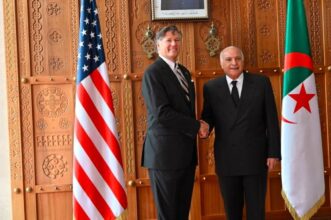
Article : Christopher Landau à Alger : le Sahara marocain au cœur des échanges, sur fond de soutien croissant à l’autonomie
La visite du secrétaire d’État adjoint américain Christopher Landau à Alger intervient dans un contexte de consolidation des soutiens internationaux à la souveraineté du Maroc sur le Sahara, alors que Washington maintient sa position en faveur de l’initiative marocaine d’autonomie.

Article : Enseignement supérieur. La promesse d’une hausse de 1.000 DH nets remise en cause ?
La revalorisation salariale de 1.000 DH annoncée dans l’enseignement supérieur suscite de vives tensions avec les syndicats. Les modalités de calcul de cette augmentation sont jugées inéquitables et engendrent des disparités importantes entre les fonctionnaires.