Hydrocarbon exploration awaiting a new boost after the ONHYM reform
The change in ONHYM’s status comes at a pivotal moment, as Morocco’s oil exploration sector has slowed in 2025. Is this pause the prelude to a new dynamic, or a strategic step back to reassess promotional strategies?

As the ONHYM prepares to transition to the status of a public limited company, Morocco’s exploration sector is slowing compared to last year. This is not the result of poor performance, but rather the natural maturation of several projects, particularly in gas.
Despite this context, Morocco is preparing to launch initial production of 100 million cubic meters from the Tendrara field, with commissioning scheduled between late 2025 and early 2026.
The Tendrara project crowns more than a decade of development, supported by ONHYM, which facilitated exploration progress, particularly drilling campaigns.
This milestone, the fruit of nearly twenty years of sustained effort, offers a timely opportunity to attract new partners capable of unlocking additional resources, especially in gas.
Exploration outcomes in 2025
Drilling activity this year was limited to the Mou-5 well drilled in March 2025 by the British company Predator Oil & Gas, which yielded no gas discovery.
Meanwhile, Mana Energy and Sound Energy had planned two exploration wells in the Tendrara and Anoual licenses but were unable to proceed. These wells are critical to increasing certified reserves and advancing to phase 2 of the Tendrara project.
At the Anchois field, the company Chariot announced a restructuring plan separating its exploration activities from its green energy portfolio. As part of this plan, to be finalized before the end of 2025, Chariot is considering resizing the field to enable rapid, cost-effective exploitation.
The year also saw Genel Energy's withdrawal: the company chose not to renew its offshore Lagzira license expiring in June 2025, nor to enter the extension period, despite being close to a new oil discovery.
The Banasa-1 well, which Genel had planned to drill, lies in a reservoir with strong potential near a 2014 well that revealed oil, albeit in non-commercial quantities.
Despite high probabilities of a large find, Genel failed to secure a financial partner, even after engaging a petroleum promotion firm.
Current status of oil exploration blocks
While discoveries remain promising, particularly with Tendrara nearing production, the last official exploration permit dates back to July 2024, signed with major oil company Esso.
Several permits have not been renewed to date, including the onshore Haha area (previously developed by a Sino-Pakistani company) and offshore blocks in Dakhla and Boujdour. No official decision has been announced regarding their transition from reconnaissance to exploration permits.
The broader trend shows many oil companies shifting focus to West Africa, where significant reservoirs have recently been discovered, in Côte d'Ivoire, Ghana, Mauritania, Senegal, and Angola.
Against this backdrop, with projects at Tendrara, Anchois, and Guercif reaching maturity, Morocco must inject fresh momentum into exploration. Operators are awaiting a stronger role from ONHYM, particularly in financing projects with more advanced risk-sharing than before.
Promising exploration results in Morocco
Compared to earlier periods, cumulative research by various operators, including major exploration companies, has identified hundreds of significant oil and gas prospects, confirming the presence of hydrocarbons in Morocco (Lagzira oil, Gharb gas, Tendrara gas, Anchois gas, Guercif gas).
However, their presence may face technical challenges as seen in the Loukos onshore license (presence of water) and Guercif (formation damage).
Yet technical challenges persist, as seen in the Loukos onshore license (presence of water) and Guercif (formation damage).
Predator's latest communication was misinterpreted as signaling withdrawal. In reality, this exploration junior, listed on the London Stock Exchange, lacks the liquidity to fund advanced development phases.
In the coming months, Predator must certify Guercif's resources through an updated technical report for potential buyers. This will consolidate discoveries, including gas identified in the four drilled wells and the confirmed presence of helium.
Predator estimates that its asset has advanced from having no identified resources to a contingent resource evaluation with growth potential. The company now considers it the right time to monetize this project.
Flashback: accelerated growth after ONHYM's creation in 2005
ONHYM's creation in 2005, through the merger of ONAREP and BRPM, triggered rapid acceleration in Morocco's oil exploration. The country, which had only five exploration permits and eight reconnaissance licenses in 1999, expanded to over 110 exploration permits by September 2008.
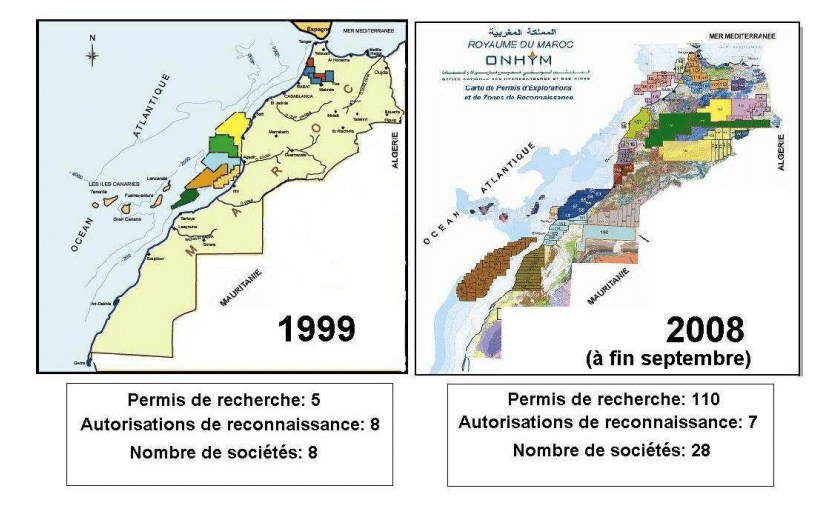
From 2005 to 2025, ONHYM built significant expertise in oil promotion and exploration (developing onshore blocks and thousands of kilometers of 2D seismic onshore and offshore). This helped demonstrate the hydrocarbon potential of Morocco’s subsoil, once questioned for its viability.
This momentum particularly favored offshore exploration, with 45 exploration wells drilled, paving the way for the Anchois gas discovery, first identified in 2009 and confirmed in 2021.
With such foundations, ONHYM's imminent change of status is seen as a chance to revive oil exploration by capitalizing on past achievements in hydrocarbons and mining.
Beyond exploration, ONHYM is expected to play a strategic role in the Atlantic-Africa gas pipeline (GAA), which will channel natural gas to 13 African countries and three landlocked Sahelian states—potentially transforming regional socio-economic development.
à lire aussi
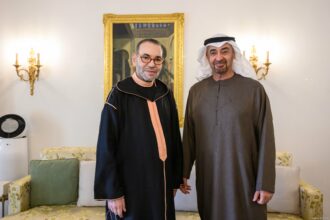
Article : Le Roi Mohammed VI s'est réuni à Rabat avec Cheikh Mohammed Ben Zayed Al-Nahyane
Le Roi Mohammed VI et Cheikh Mohammed Ben Zayed Al-Nahyane se sont rencontrés à Rabat dans le cadre de la visite privée que le Président de l’État des Émirats arabes unis effectue au Maroc. Les questions et défis que connaît la scène internationale, en particulier ceux qui concernent les États du Golfe et du Moyen-Orient, étaient au cœur de la rencontre.
Article : Préparation CDM 2026. Le Maroc s’impose sans peine face à Madagascar (4-0)
Les Lions de l’Atlas n’ont pas eu à forcer leur talent pour l’emporter face à des Malgaches limités, ce mardi 2 juin à Rabat, grâce notamment à un doublé d’Ismaïl Saibari. Les enseignements positifs ont été nombreux, mais le manque d’efficacité demeure un point noir en vue du Mondial 2026.
Article : Batteries : pourquoi le modèle industriel marocain inquiète-t-il Bruxelles
L’Union européenne durcit sa position face aux investissements chinois. Avec les projets chinois dans l’automobile électrique et les batteries, le Maroc se retrouve au cœur de cette nouvelle tension. Le précédent des jantes en aluminium montre que cette pression peut déjà se traduire par des droits commerciaux lourds. Le Royaume entend défendre ses intérêts. Des discussions sont en cours.
Article : Visa Fintech Day : le Maroc veut accélérer l’inclusion financière grâce à l’IA et aux paiements numériques
Rapprocher les services financiers des citoyens, soutenir les TPME et réduire les fractures d’accès… Le Maroc mise sur l’IA et la fintech pour accélérer sa transformation numérique.
Article : 1.700 passagers et 426 cabines : GNV baptise à Tanger son navire Aurora le plus moderne
Avec le baptême du GNV Aurora à Tanger, la compagnie maritime italienne GNV renforce son dispositif entre le Maroc, l'Espagne et l'Italie. Déployé à l'approche de l'Opération Marhaba 2026, ce ferry de nouvelle génération illustre les ambitions du groupe en matière de mobilité, de confort des passagers et de transition énergétique.
Article : Mines : ce que cachent les annonces de découvertes au Maroc
Le secteur minier marocain est en pleine effervescence. Mais entre l'effet d'annonce et la réserve prouvée, le chemin reste long et incertain. Décryptage d'un secteur où il faut savoir démêler le vrai du spéculatif.