
Ouahbi’s Strategy Against Corruption: A Lockdown That Sparks Debate
Abdellatif Ouahbi continues to defend his vision of how to fight corruption. A stance that raises sharp questions.
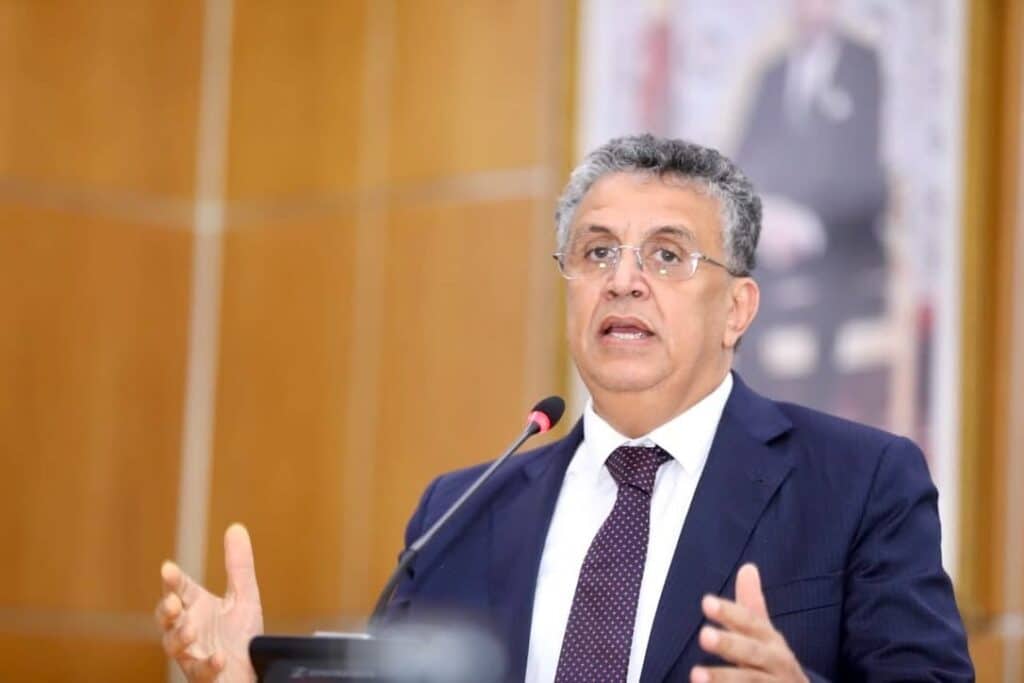
Since 2021, Justice Minister Abdellatif Ouahbi has pursued a course that limits the number of entities authorized to initiate prosecutions in cases of corruption and mismanagement of public funds.
The recent budget debates in Parliament offered him yet another occasion to reaffirm his position, which further narrows the scope for opening judicial investigations against officials.
Starting from 4.00:00
In 2021, the criminalization of illicit enrichment was slated for inclusion in the Penal Code. The measure was ultimately withdrawn by the head of government, following a request from the Minister of Justice.
At the time, this decision was justified as a need for "harmonization" with other texts, notably the Code of Criminal Procedure. Yet, several actors perceived it as the minister's intention to exclude a mechanism that could target political or administrative officials; namely, the criminalization of illicit enrichment.
Since then, Abdellatif Ouahbi has stood firm in his opposition to this criminalization, arguing that it could expose officials to unfounded complaints.
On November 12, during the parliamentary review of his department’s budget, he reiterated his position: in his view, the lack of sufficient safeguards to protect public servants from false accusations poses a major risk. "What guarantees are there for officials? There are none," he declared, invoking the presumption of innocence enshrined in the Constitution.
Unjustifiable Immunity?
This line had already appeared in his earlier interventions. In January 2024, he argued that the Penal Code as a whole already addressed illicit enrichment while safeguarding the presumption of innocence, stressing the need to balance accountability with procedural guarantees. The minister has consistently maintained that corruption exists, but that Moroccan society also comprises "serious" individuals, and the state must protect the innocent.
Yet this argument can also be read from the opposite perspective. Protecting the innocent should not eclipse the problem of genuinely corrupt officials. By drastically curtailing the avenues for justice, the system inevitably opens a space of impunity for those who abuse their positions. The fact that not all officials are corrupt, which is self‑evident, does not justify dismantling a control mechanism that has, over the years, proved a useful tool for uncovering irregularities.
Some observers draw a simple analogy: one cannot ban the purchase of knives simply because some use them to commit crimes. Likewise, the existence of abusive complaints should not justify depriving civil society as a whole of the ability to alert the justice system. Safeguards already exist, or can be reinforced, without resorting to a blanket prohibition.
An Approach Already Adopted
This approach is now reflected in the new Code of Criminal Procedure. The text has removed the right of associations for the protection of public funds to file complaints in cases of financial crime. From now on, only public institutions, such as the Court of Auditors, general inspectorates, or the public prosecutor's office, are authorized to bring cases before the courts.
According to the minister, this refocusing is necessary. He contends that certain associations are being manipulated by actors seeking to interfere in politics. He believes that unfounded complaints risk harming local officials, and that protecting them remains a priority.
Yet this position is far from consensual. Several parliamentarians and civil society actors see it as a setback in the fight against corruption. They stress that many cases uncovered in recent years have originated from complaints filed by associations, which often step in to offset structural shortcomings — institutional workload, investigative constraints, or lack of initiative. Some also recall that specialized public institutions have argued in favor of preserving the ability of associations to take legal action.
A Constitutional Issue
The removal of this right also raises a constitutional concern. Citizens are guaranteed access to justice. Limiting this faculty to certain categories, even in the name of sound administration of justice, calls into question the balance of powers and civil society’s capacity to play a monitoring role.
The minister insists that the fight against corruption must be led by "rigorous state institutions," in his words. He describes corruption as an "invisible" phenomenon, difficult to grasp, and requiring disciplined, regulated structures.
Critics, however, counter that excluding associations weakens a vital monitoring channel. They argue that the fear of abusive complaints does not justify sidelining actors who have helped uncover major cases. They also stress that less radical remedies exist to curb abuses — such as regulating communication around complaints or imposing sanctions for frivolous filings.

à lire aussi
Article : Éducation : le Maroc renforce sa coopération avec l’université chinoise Beihang
Le ministère marocain de l’Éducation nationale, du Préscolaire et des Sports a signé vendredi 17 avril à Rabat une convention de partenariat avec l’université chinoise Beihang University, visant à renforcer la coopération bilatérale en matière d’enseignement, de recherche scientifique et d’innovation technologique.

Article : Sahara : Bruxelles se projette déjà sur l’investissement
Sur Medi1TV, la haute représentante de l’UE pour les affaires étrangères a présenté l’issue "politique" du différend autour des provinces du Sud comme un facteur d’accélération d’une dynamique européenne déjà amorcée sur le terrain.

Article : Agents de gardiennage : vers la fin des journées de 12 heures payées seulement 8
Le gouvernement, en concertation avec les partenaires sociaux, veut corriger une situation persistante en revoyant le cadre légal applicable aux amplitudes horaires dans la sécurité privée.

Article : Cinéma. Dans “Calle Málaga”, Maryam Touzani célèbre la vie et lève le tabou de la vieillesse
Né de la douleur, de la perte et du besoin de garder vivant le souvenir de sa mère, le nouveau film de Maryam Touzani se veut un hommage à la renaissance. Dans les rues de Tanger, la réalisatrice nous confie son souhait de transformer la vieillesse en un privilège et de faire de la fiction un espace de liberté pour filmer la persistance de l'être et l'amour de la vie.
Article : Race to the bunkers: Algiers rattled by the FAR’s technological rise
Satellite images circulating on social media point to unusual activity across the border. The Algerian army appears to be stepping up the construction of underground structures, underscoring its concern over the precision of Moroccan strike systems.

Article : Mondial 2030. Où en sont les chantiers des stades de Casablanca ?
Casablanca accélère la modernisation de ses infrastructures sportives à l’approche de la Coupe du monde 2030. Plusieurs stades emblématiques de la ville font l’objet de projets de réhabilitation ou de reconstruction, avec des investissements importants mobilisés. Round-up.