
SGTM launches Morocco’s largest IPO since 2004: strategy, vision, and ambitions
This 5.04‑billion‑dirham operation, conducted entirely through a divestment, stands as the largest since Maroc Telecom’s 2004 IPO. At its press conference, management outlined the objectives of the operation, presented the key figures of the business plan, and detailed all subscription modalities.
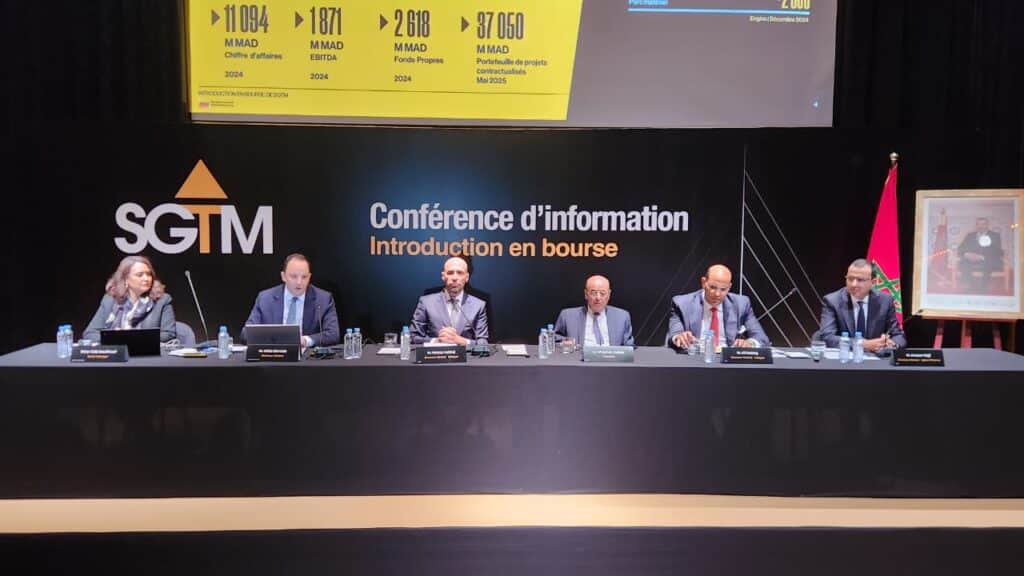
SGTM held its press conference on November 19 to unveil the details of its stock market debut, an operation structured around the sale of 12 million shares for a maximum of 5.04 billion MAD.
The meeting highlighted the group’s fundamentals and presented the key forecasts underpinning its business plan, offering a degree of visibility rarely achieved in the construction sector.
100% IPO by sale: a strategic choice
"For us, a capital increase should serve to finance development. Today, SGTM’s growth is self-financed," explained Mr. Berrada.
"We operate within a structure that is not indebted. Our debt amounts to around 1.4 billion, more than 75% of which is leasing. In consolidated accounts, it appears as a debt, but in reality it finances equipment. It is not genuine debt."
"Today, we have a structure with solid equity. But above all one with significant borrowing capacity. Proposing a capital increase now to secure limited liquidity is more typical of high-value structures."
"It should be noted that numerous past operations on the Casablanca Stock Exchange have been conducted through sales. A capital increase is not, in itself, the norm."
Of course, if tomorrow SGTM undertakes a major investment project, whether an acquisition, an industrial investment, or any initiative requiring capital contribution, it is obvious that a capital increase will be considered.
"Financial agility is precisely what gives us access to these markets. We have seen it in other listed companies, TGCC, Mutandis, Managem. The IPO serves two objectives: to institutionalize and ensure sustainability, and to achieve a financial objective, being present in the market and able to react when needed."
Acknowledged timing amid market correction
Certainly, several questions arise regarding the timing and the Moroccan market’s capacity to absorb an operation of this scale, as well as its impact on stock market dynamics. This aspect will be examined in depth in the following article.
Regarding the market, Mohamed Idriss Berrada, Managing Director of Attijari Finances Corp noted: "The market has experienced significant developments. There has been a very strong upward trend in recent years. In recent weeks, we may be seeing some profit-taking, which is quite normal in a market, but it does not reflect a fundamental trend."
"We are in a dynamic where investment is currently very strong, with projects underway. Activity is abundant across infrastructure, industry, or energy. This represents a fundamental trend, unaffected by the profit-taking movements currently observed in the market."
"We have confidence in the quality of the stock. We know that the financial market is not only about rising prices, but also about their fluctuations. We believe the current trend is normal, and there is no reason to wait until 2026."
The second aspect concerns the group’s internal timing. "The idea of going public is not new; we set a meeting 15 years ago and were already discussing it then. It should be recalled that in 2007, SGTM had obtained approval. [...] Timing and perfection do not exist; there are opportune moments. I believe the timing is right for the sector, for the Moroccan stock market. Our economy is growing," explains Hamza Kabbaj, Managing Director of SGTM.
"There is a macroeconomic solidity in what is happening in our country. We do not assess a country's solidity based on daily market fluctuations. We are convinced of the solidity of both the company's and the country's fundamentals. I believe the timing is excellent. The company has undertaken structuring projects, internal, organizational, and capital restructuring, among others. Precisely, to prepare for this, I think in terms of readiness, they are ready," explains Mr. Berrada.
Some figures and forecasts from SGTM
By the end of 2024, SGTM’s order book stood at 16.5 billion MAD. Between January and May 2025, this volume increased by 20.4 billion MAD, bringing the total to 37.05 billion dirhams.
This operation remains natural for a construction company, as projects are executed over several years and gradually extinguish as they are delivered. From 2029 onwards, revenues from currently signed contracts will reach their term, which is inherent to the nature of the activity.
For the following years, forecasts are based on an additional pipeline of 15 billion MAD per year of projects that should take over from the current order book.
The company anticipates a continuity of activity and growth in line with the macroeconomic trends of the sector.
Visibility after 2028
"The fact that our order book extends until 2028 is linked to the intrinsic functioning of a construction company. The order book consists of projects to be delivered. We secure them as we go along."
"Visibility, I believe, in 2028 is already exceptional. Projects continue to emerge. There is a project pipeline, as I mentioned earlier, of nearly 1 trillion. SGTM will have its share of this pipeline, which will generate additional order book entries and be updated over the years.
It is a transparency move to demonstrate that there is a solid capacity to execute and win business. We are clearly not in a slowdown vision for 2028. This is not our narrative at all. We believe that 2030 is a starting point and not a finish line," explains Hamza Kabbaj.
"This is not our narrative at all. On the contrary. We believe that 2030 is a starting point and not a finish line," he adds.
Working Capital Management: advance payment, pre-financing, and innovation
Regarding working capital management, the management provides a very detailed response. "In the 37 billion MAD, there are contracts, a significant part, where the contractual conditions give us an advance at the start. This advance at the start is essential to ensure the working capital needs," explains Hamza Kabbaj. "Unfortunately, it is not generalized as other contracts do not provide it. This requires a bit more engineering and a bit more agility."
"When there is a large project that contractually does not provide an advance at the start, we have structured financing tools with our banking partners or others. The classic scheme is bank pre-financing: based on the contract, the bank provides us with a financing line that allows us to fund the startup working capital."
"We have innovated on other projects, notably at the Dakhla port, where we introduced in Morocco what we call the project bond. That is, we issue a bond on the market that allows us to raise funds to meet these startup working capital needs."
"Equity and part on supplier debt provide us with a healthy financial structure and allow us to meet these major working capital needs."
Africa Strategy: cautious but assertive presence
"I said we were cautious, but that does not mean we are not there. We are present in seven countries... Each country has its political, economic realities," explains the MD.
"The caution comes from the choice to pursue projects backed by international financing organizations to avoid payment risks, to avoid putting the company in difficulties."
"The way to deal with it is to structure ourselves and provide financing schemes that accompany certain projects — for a greater presence in the countries where we already operate, or even opportunistically in countries where we are not yet present."
Competitive Differentiation: integration, expertise, and industrial EPC
Finally, on what sets SGTM apart from its competitors:
"You know, we can quickly make the mistake of saying that all construction companies are the same. But SGTM’s specificity lies in the presence of a truly specialized team."
"We are the most integrated company in the sector. We do not depend on a technical ecosystem for subjects such as special foundations, significant lifting, or the manufacture of metal structures. Today, it is an integrated group. This integration sets us apart from the sector," explains Mr. Kabbaj.
SGTM is the only Moroccan company to have built industrial units — including the technological process — to deliver a cement plant or a fertilizer plant with 100% of the necessary skills."
"This is an extremely important element in Morocco’s future. Major clients want to go through strategic EPCs, and I think SGTM is becoming the essential player in this type of setup."
Operation Details and Subscription Terms
The maximum amount of the operation is set at 5.04 billion MAD, corresponding to the listing of 12 million shares on the market.
The reference introduction price is 420 MAD per share, but two types of orders benefit from significant discounts: 340 MAD for employees (Type I) and 380 MAD for individual investors and certain legal entities (Type II).
The subscription period runs from December 1 to December 8, 2025, at 3:30 p.m., and the first listing is scheduled for December 16, 2025.
The operation takes place in the form of a firm price offer, and the shares will be admitted to the main market, compartment A, under the ticker GTM.
The offer is structured around four types of orders, each with its own conditions, prices, and ceilings.
-
- Type I – Employees and retirees of SGTM group and subsidiaries/sister companies Price: 340 MAD (lowest) Ceiling: equivalent to 24 months of gross salary
- Type II – Unqualified individuals and legal entities Price: 380 MAD Ceiling: 13,158 shares (≈ 5 million MAD)
- Type III – Unqualified individuals or legal entities at 420 MAD Price: 420 MAD Minimum: 11,905 shares (≈ 5,000,100 MAD) Ceiling: 10% of total shares offered
- Type IV – Qualified Moroccan and foreign investors Price: 420 MAD Minimum: none Ceiling: 10% of total shares offered Special rule: UCITS capped at 10% of the offer and 10% of their net assets
"Institutionalizing the company for sustainability"
SGTM's IPO pursues several structuring objectives that are in line with its development.
One of the main challenges is to institutionalize the company by opening up its capital further and associating new partners with its trajectory. This openness should allow SGTM to consolidate its governance and establish its model sustainably.
The operation also aims to strengthen the group's visibility and bring it closer to institutional investors as well as the general public. The IPO is thus a decisive step to broaden its visibility and assert its position in the Moroccan market.
SGTM also seeks to continue and intensify the logic of transparency and performance that it has been deploying for several years. The listing formalizes this approach by introducing increased requirements in terms of financial information and governance.
Another essential objective is to increase the group's financial agility. Direct access to the capital markets should facilitate the use of external financing, optimize costs, and offer SGTM enhanced capacity to support its future projects. This is part of a broader desire to have more flexible financing tools, particularly in a sector where size and speed of execution are crucial.
The operation also provides liquidity to current shareholders, while opening the door to a broader shareholder base. Finally, SGTM wishes to involve its employees in the company's dynamics and share with them the value creation, in a logic of long-term commitment and motivation.
De la vision des frères Kabbaj à un groupe intégré : comment la SGTM s'est muée en géant du BTP
à lire aussi
Article : Ligue des champions de la CAF : l’AS FAR élimine la RS Berkane et rejoint Mamelodi Sundowns en finale
Battu 1-0 à l’extérieur, le club rbati a validé son billet grâce à son succès 2-0 à l’aller, retrouvant l’ultime rendez-vous continental pour la première fois depuis 1985, où il avait été sacré.
Article : Éducation : le Maroc renforce sa coopération avec l’université chinoise Beihang
Le ministère marocain de l’Éducation nationale, du Préscolaire et des Sports a signé vendredi 17 avril à Rabat une convention de partenariat avec l’université chinoise Beihang University, visant à renforcer la coopération bilatérale en matière d’enseignement, de recherche scientifique et d’innovation technologique.
Article : Sahara : Bruxelles se projette déjà sur l’investissement
Sur Medi1TV, la haute représentante de l’UE pour les affaires étrangères a présenté l’issue "politique" du différend autour des provinces du Sud comme un facteur d’accélération d’une dynamique européenne déjà amorcée sur le terrain.

Article : Agents de gardiennage : vers la fin des journées de 12 heures payées seulement 8
Le gouvernement, en concertation avec les partenaires sociaux, veut corriger une situation persistante en revoyant le cadre légal applicable aux amplitudes horaires dans la sécurité privée.

Article : Cinéma. Dans “Calle Málaga”, Maryam Touzani célèbre la vie et lève le tabou de la vieillesse
Né de la douleur, de la perte et du besoin de garder vivant le souvenir de sa mère, le nouveau film de Maryam Touzani se veut un hommage à la renaissance. Dans les rues de Tanger, la réalisatrice nous confie son souhait de transformer la vieillesse en un privilège et de faire de la fiction un espace de liberté pour filmer la persistance de l'être et l'amour de la vie.
Article : Race to the bunkers: Algiers rattled by the FAR’s technological rise
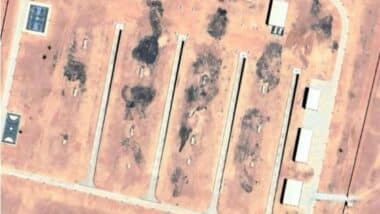
Satellite images circulating on social media point to unusual activity across the border. The Algerian army appears to be stepping up the construction of underground structures, underscoring its concern over the precision of Moroccan strike systems.