
AFCON 2025. How Morocco can beat Cameroon (video analysis)
Video Analysis. Morocco’s national team meets Cameroon on Friday, January 9 at 8 p.m. in Rabat, with a place in the 2025 Africa Cup of Nations semifinals at stake. Beyond the continental showdown, the clash will oppose two sides built on sharply contrasting playing philosophies. Here are the tactical keys that could tilt the balance in Morocco’s favor.

Predicting with certainty the outcome of the Africa Cup of Nations quarter-final between Morocco and Cameroon—Friday, January 9 at 8 p.m. at Rabat’s Prince Moulay Abdellah Stadium—would be no easy feat.
Beyond the mental dimension inherent in knockout matches, which will inevitably shape the result, this high-level clash opposes two contrasting football philosophies.
On one side stand the Atlas Lions, intent on dominating possession, dictating the tempo, and advancing methodically toward goal, relying on their players’ technical quality and precision.
On the other, the Indomitable Lions, defensively solid, capable of breaking forward at speed.
"Cameroon boast defensive strength, anchored by an organized back five and a highly athletic midfield," noted Morocco’s head coach Walid Regragui during his pre-match press conference on Thursday, January 8 in Rabat.

The main tactical aspects of this clash can be summed up in four key points:
- Morocco’s potential need to adjust its system
- Cameroon’s aggressive pressing strategy
- The management of transitions, a decisive factor
- The influence of Bryan Mbeumo and Carlos Baleba

Why a back three could make sense
Facing an opponent as direct and powerful as Cameroon, Morocco’s tactical setup becomes a key question.
Since the start of the tournament, the Atlas Lions’ defence has shown vulnerabilities, especially against runs in behind and during defensive transitions.

There are strong arguments for a tactical reshuffle. Nayef Aguerd continues to struggle with adductor problems, Achraf Hakimi is only just back from injury, and both Adam Masina and Jawad El Yamiq remain short of match fitness, having barely featured since the beginning of the club campaign.
In contrast, Abdelhamid Aït Boudlal stands out as the only central defender to have consistently competed at a high level this season, yet he still occupies a modest place in Walid Regragui’s hierarchy.
In such circumstances, alternating at times to a three-man back line could give Morocco added defensive assurance.

By adopting this system, Morocco would gain added protection behind full-backs who often surge forward, while shoring up the central zone against Cameroon’s lightning-fast counters.
The approach would provide a sturdier defensive platform—an asset against a team that thrives on speed and vertical play.
It would also unleash the wing-backs, Achraf Hakimi and Anass Salah-Eddine, allowing them to widen the pitch and make incisive attacking runs.

Such an approach is vital against a Cameroonian team that defends in depth and seeks to shut down the central corridor.
Within this framework, Noussair Mazraoui could play a pivotal role. Having operated in a back three for more than a year at Manchester United, he brings both tactical intelligence and quality in the build-up, helping Morocco launch attacks more smoothly.
Depending on the configuration, the system could even morph into a 4-2-3-1, with Hakimi pushed high on the right flank.

The main limitation, however, lies in the players’ mutual understanding.
Despite Morocco’s wealth of top-level talent able to adapt quickly, the 2022 World Cup semi-final demonstrated that shifting to a back three overnight is never straightforward—particularly in a high-stakes encounter.
Cameroon's high press: a calculated risk
The Indomitable Lions typically defend with a high press, relying on individual marking.
This strategy pushes numerous players into the opponent’s final third, aiming to disrupt build-up and force turnovers high up the pitch.

This aggressiveness comes at a cost. Once the first pressing line is broken, Cameroon often end up defending in numerical equality—or even inferiority—behind.
That imbalance was exposed against Ivory Coast, in the move leading to Amad Diallo’s goal, when a clean ball exit dismantled the Cameroonian defensive setup.

Statistically, Cameroon’s pressing is far from flawless. Metrics on passes allowed per defensive action indicate that the team ranks among the less effective sides in this area of the competition.

Morocco’s ability to remain precise under pressure, to retain possession and then release it swiftly, may prove the crucial weapon in breaking down Cameroon’s defensive structure.
Transition management: Cameroon's main threat
If there's one area where Cameroon excels, it's in transitions. The Indomitable Lions are particularly dangerous when they lose the ball and regain it immediately, with several players already positioned high in the opponent's half.

In these situations, forward transitions are immediate, with few passes and deliberate verticality.
The danger peaks when recovery occurs high up the field: Cameroon exploit the spaces left by a disorganized block, turning a simple regain into a clear chance within seconds.
For Morocco, mastering these moments is crucial—limiting turnovers in sensitive zones, ensuring preventive coverage, and maintaining defensive balance after losing possession.
Bryan Mbeumo is a prime beneficiary of these transitions. With pace, one‑on‑one ability, and incisive runs, he remains a constant threat whenever Cameroon surge forward.

Behind him, Carlos Baleba occupies a central role in this mechanism.

He often delivers the first pass after recovery, opting for vertical or deep balls to launch the forwards behind the opposing block.
Together, they embody Cameroon’s identity—a duo against whom any slip can prove costly. The Atlas Lions have been duly warned.

à lire aussi
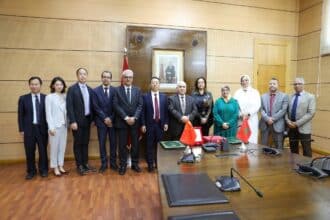
Article : Éducation : le Maroc renforce sa coopération avec l’université chinoise Beihang
Le ministère marocain de l’Éducation nationale, du Préscolaire et des Sports a signé vendredi 17 avril à Rabat une convention de partenariat avec l’université chinoise Beihang University, visant à renforcer la coopération bilatérale en matière d’enseignement, de recherche scientifique et d’innovation technologique.

Article : Sahara : Bruxelles se projette déjà sur l’investissement
Sur Medi1TV, la haute représentante de l’UE pour les affaires étrangères a présenté l’issue "politique" du différend autour des provinces du Sud comme un facteur d’accélération d’une dynamique européenne déjà amorcée sur le terrain.

Article : Agents de gardiennage : vers la fin des journées de 12 heures payées seulement 8
Le gouvernement, en concertation avec les partenaires sociaux, veut corriger une situation persistante en revoyant le cadre légal applicable aux amplitudes horaires dans la sécurité privée.

Article : Cinéma. Dans “Calle Málaga”, Maryam Touzani célèbre la vie et lève le tabou de la vieillesse
Né de la douleur, de la perte et du besoin de garder vivant le souvenir de sa mère, le nouveau film de Maryam Touzani se veut un hommage à la renaissance. Dans les rues de Tanger, la réalisatrice nous confie son souhait de transformer la vieillesse en un privilège et de faire de la fiction un espace de liberté pour filmer la persistance de l'être et l'amour de la vie.
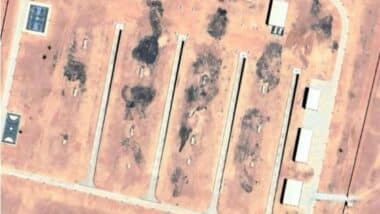
Article : Race to the bunkers: Algiers rattled by the FAR’s technological rise
Satellite images circulating on social media point to unusual activity across the border. The Algerian army appears to be stepping up the construction of underground structures, underscoring its concern over the precision of Moroccan strike systems.

Article : Mondial 2030. Où en sont les chantiers des stades de Casablanca ?
Casablanca accélère la modernisation de ses infrastructures sportives à l’approche de la Coupe du monde 2030. Plusieurs stades emblématiques de la ville font l’objet de projets de réhabilitation ou de reconstruction, avec des investissements importants mobilisés. Round-up.