
Hot Topics in Electoral Reform: Sponsorship and Fake News
Two provisions of the electoral reform are under debate: the sponsorship of social media publications and measures to combat electoral fake news.

Electoral reform is advancing in Parliament, but two articles are fueling debate.
One provision would ban sponsored publications on foreign platforms. Another introduces a new penal mechanism against electoral fake news.
Members of Parliament passed the provisions in committee, as part of the reform of Law 27.11 on the House of Representatives. But several questions remain.
The text does not specify when the bans and sanctions will take effect.
The reform will take effect once published in the Official Bulletin, but it remains unclear whether the ban on sponsored publications applies only during the campaign period or permanently.
The ambiguity runs deeper. Article 51 bis, which addresses false information related to elections, was amended to clarify which cases are covered. The committee retained the article in revised form, but doubts remain.
Before examining the two articles, it is worth revisiting how Moroccan political parties interact with social networks.
Since 2021, observers have noted a new way political parties are engaging online. The extensive use of digital platforms has shifted the balance of the electoral campaigns, often favoring parties with greater resources and more structured communication strategies.
2021: RNI Leads in Sponsored Content
In September 2021, Médias24 reported a clear disparity among political parties.
The RNI dominated the digital space by publishing content continuously and boosting visibility through sponsorship. The strategy was not prohibited, as it took place outside the official campaign period.
- Facebook data showed the RNI spent more than $211,000 on sponsored content between March 11 and August 29, 2021.
- Istiqlal followed with $21,631, while other parties trailed far behind — PPS ($1,736), MP ($1,331) and PAM ($630).
- The FGD, USFP, PJD and UC each spent less than $450.
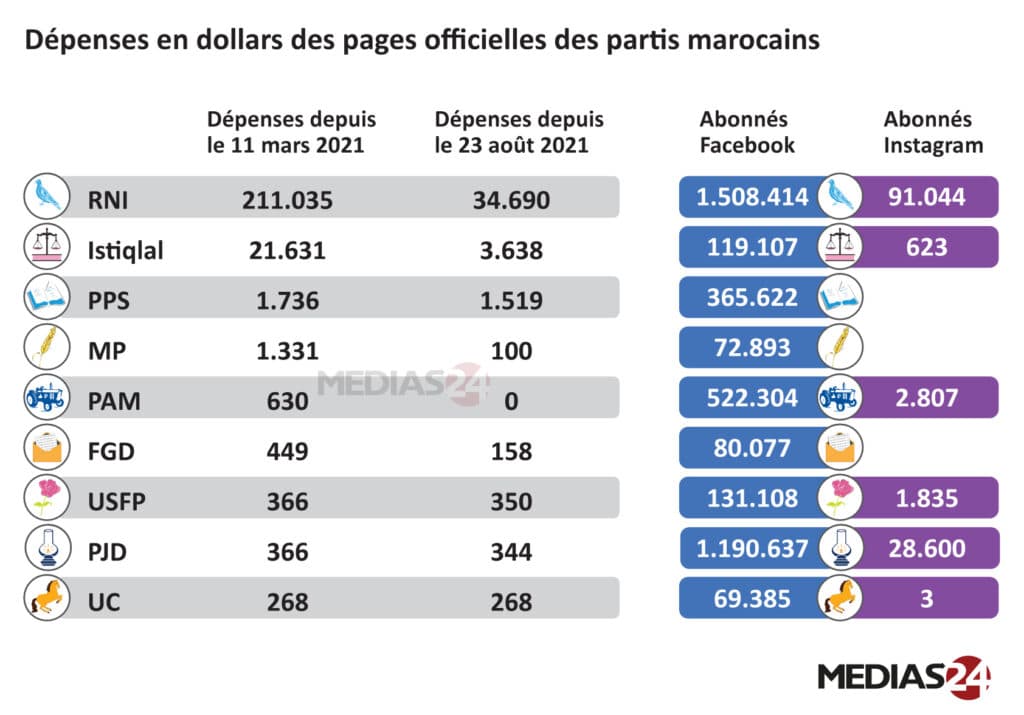
The discrepancies were reflected in audiences: the RNI had more than 1.5 million Facebook subscribers, ahead of the PJD with 1.19 million. Both were far ahead of the PAM (522,000) and PPS (365,000). The gap widened on Instagram, where Istiqlal and PPS remained marginal while the RNI topped 90,000 subscribers.
A study by the German Institute for Global and Area Studies (GIGA) analyzing the 2021 digital campaign found the RNI to be the most structured party, with YouTube playlists organized by themes, target audiences and duration. The PJD, by contrast, offered fewer videos, less structured and less attractive.
The study shows the RNI invested $252,633 in its digital campaign, including $10,010 on Aziz Akhannouch’s page. In comparison, the PJD spent only $851 on its official website and $138 on Saadeddine El Othmani’s page.
The PAM, PPS and RNI youth each spent between $5,000 and $8,000.
The figures highlight how social networks now play a central role, with resource disparities influencing electoral competition.
Countering Foreign Interference
In this context, the government introduced Article 40, banning sponsored publications on foreign platforms.
Parliamentary discussions confirmed the measure aims to block foreign interference in Moroccan elections, a risk the Executive considers real.
Deputy Nabila Mounib (PSU) opposed the ban, arguing that while fears of external intervention may be legitimate, the text unnecessarily restricts the digital engagement of Moroccan expatriates.
Her arguments did not sway colleagues, and Article 40 was retained in the version proposed by the government.
Combatting Fake News
The debate intensified around Article 51 bis, which provides prison sentences and fines for manufacturing and disseminating false content related to elections. The committee adopted a revised version of the text.
In its original version, Article 51 bis set penalties of two to five years in prison and fines of 50,000 to 100,000 dirhams for:
- anyone who disseminates, publishes, or shares statements or images of a person without consent;
- or disseminates or shares false information, allegations, or falsified facts, or altered documents, with the aim of infringing on the privacy of a voter or a candidate, or defaming one of them;
- but also against anyone who performs or participates, through any of the means mentioned below, in the dissemination, publication, or transmission of rumors or false news aimed at casting doubt on the credibility or integrity of the electoral process.
This second part of Article 51 bis was indeed amended, but its overall spirit was preserved; contrary to the request of the PJD, which rejected the article.
The Lamp party (PJD) believes that the described mechanism threatens freedom of expression and duplicates offenses already established in the Penal Code, the Press Code, or other legislation.
Ultimately, the version retained of the last paragraph of this article is the one that sanctions anyone who, "by any means — including social networks, open broadcasting networks (live, ed.), artificial intelligence tools, or any electronic platform, Internet-based application or computer system — creates false or falsified content aimed at undermining the transparency and integrity of the electoral process."
In this version, the term "rumors" was dropped. This change responds to an argument presented by Deputy Nabila Mounib. During the committee discussion, the deputy stated that she supports fostering debate but opposes stifling it.
According to her, "the electoral period is a time for discussion and exchange. It is therefore natural for certain information to circulate, sometimes difficult to verify or resembling rumors. But in any case, they must remain free from defamation and direct harm to the candidate."

à lire aussi

Article : Au-delà du bilan Akhannouch, lecture des indicateurs du marché du travail
Sous le gouvernement Akhannouch, le marché de l’emploi reste le principal point de fragilité de l’économie. Ce problème est ancien mais s’aggrave au fil du temps. Médias24 confronte les engagements du gouvernement à ses réalisations et analyse, au-delà du mandat, plusieurs indicateurs du marché du travail sur une longue période.
Article : Secteur minier. Après une année 2025 record, 2026 s'annonce déjà comme un cru très prometteur
2025 restera comme un millésime d'exception pour les mines marocaines. Cours au plus haut, volumes en hausse, nouveaux projets en maturation... Le secteur profite pleinement d'un cycle mondial porteur. Et 2026 s'annonce tout aussi favorable, sous l'effet de plusieurs signes.

Article : Ordre des experts-comptables. Élections sur fond de réflexion sur l’ouverture du capital
Le 21 mai 2026, les experts-comptables élisent les membres du Conseil national et des conseils régionaux de leur Ordre pour les trois prochaines années. Au-delà de ce renouvellement, la profession réfléchit à faire évoluer son cadre, notamment sur la question de l’ouverture du capital des cabinets. Détails.

Article : Le trafic aérien en hausse de 11,15% à fin mars 2026
L'Office national des aéroports (ONDA) a annoncé que le trafic aérien commercial dans les aéroports du Royaume a enregistré 8.913.041 passagers à fin mars 2026, soit une croissance de 11,15% par rapport à la même période de l'année précédente.

Article : Mondial 2026. Le double pivot, pierre angulaire du projet Ouahbi
Les deux milieux de terrain devant la défense constituent l’élément central du dispositif tactique du sélectionneur national. Un principe qui assure l’équilibre des Lions de l’Atlas, conditionne la récupération du ballon et la première phase de construction. Mais qui n’est pas sans risque.
Article : SIAM 2026 : malgré un taux de couverture de 60%, 450 communes rurales restent exclues des services financiers selon Bank Al-Maghrib
À Meknès, le directeur général de Bank Al-Maghrib, Abderrahim Bouazza a indiqué que 450 communes rurales restent sans services financiers malgré une couverture de 60%. Il a aussi annoncé l’équipement de 50 coopératives en TPE et rappelé que 25% des programmes d’éducation financière ont ciblé le monde rural.