
Territorial Health Groups reform faces its first real test in the field
Five directors-general appointed by the King, encouraging indicators from a pilot region, but unions pushing back and key decrees still pending. Morocco’s overhaul of its public healthcare system around Territorial Health Groups is gathering pace. The hardest part still lies ahead.
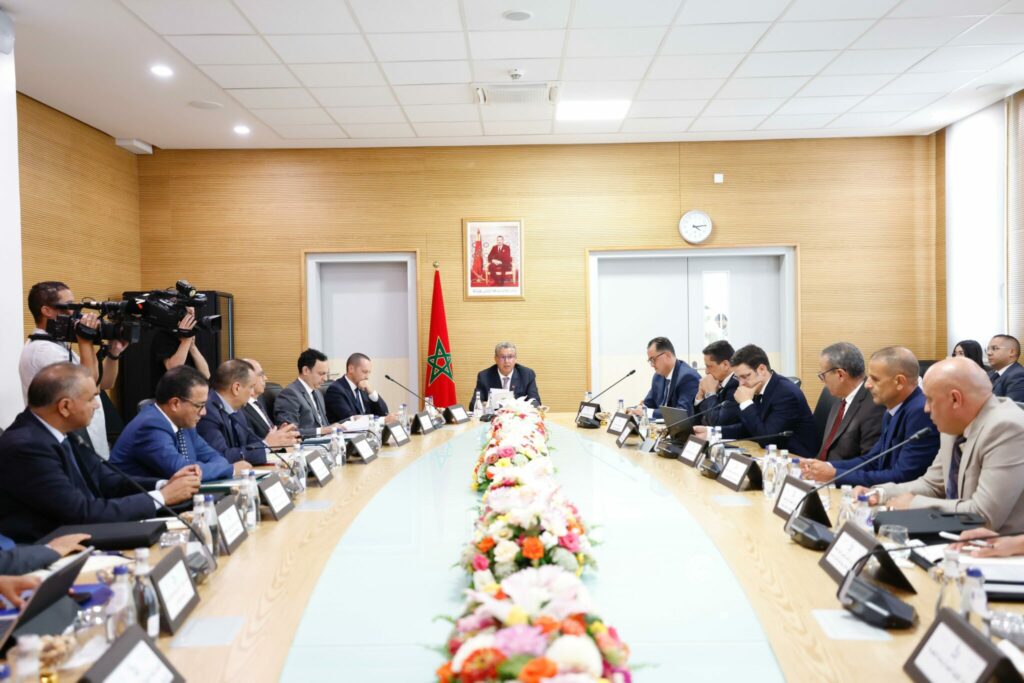
On April 9, 2026, during the Council of Ministers held at the Royal Palace in Rabat, King Mohammed VI appointed five directors-general to head the Territorial Health Groups (THGs), the new structures responsible for managing public healthcare at the regional level.
The royal appointments cover five regions: Hicham Afif will head the Casablanca-Settat THG, Brahim Lekehal that of Rabat-Salé-Kénitra, Abdelkrim Daoudi Fès-Meknès, Brahim El Ahmadi Laâyoune-Sakia El Hamra, and Tarik El Harti Souss-Massa. These groups are in addition to the one already operational in the Tanger-Tétouan-Al Hoceima region.
Twelve days later, on April 21, the Minister of Health and Social Protection, Amine Tahraoui, answered an oral question before the House of Councillors on the progress of the reform.
The rollout of the model is based on the results of the pilot region of Tanger-Tétouan-Al Hoceima, where the THG has been operational since the summer of 2025. Preliminary indicators presented by the minister show an 11% increase in medical consultations at the regional level, and a 64% rise in access to care in the province of Larache. Tahraoui also highlighted improvements in reducing appointment delays and enhancing care pathways between the end of 2024 and the beginning of 2025.
Entities with expanded powers
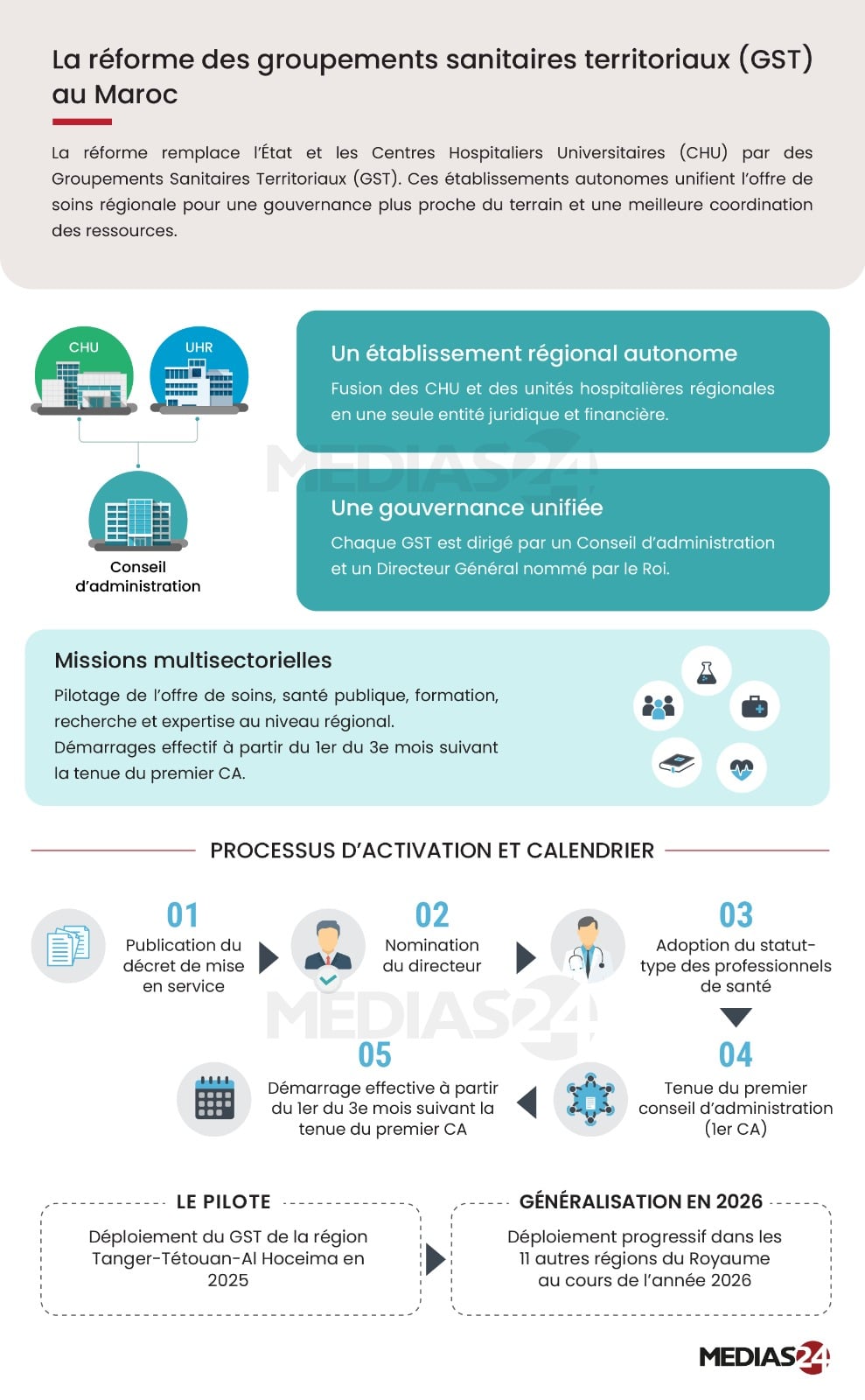
As the minister emphasized, THGs are one of the pillars of the healthcare system reform. In essence, the THG is the instrument of healthcare regionalization, designed to bring decision-making closer to the field and reduce territorial disparities in access to care.
It is a new public institution with legal personality and financial autonomy, established at the level of each region of Morocco to manage healthcare in an integrated manner. Its mission is to bring together, under unified governance, all public healthcare facilities within a region. This notably includes the integration of university hospital centers (CHUs), regional hospitals and other local facilities into a single structure.
Beyond hospital care, each group defines regional healthcare planning, organizes care pathways, ensures epidemiological monitoring, manages its human and financial resources, oversees drug supply, and licenses local private healthcare providers.
Draft decree on professional mobility under preparation
In terms of governance, each group is managed by a Board of Directors (including representatives of the State, regional elected officials and experts) and led by a Director-General. The recent appointments therefore trigger the launch process of THGs in the five regions mentioned above.
Each THG becomes operational two months after its first Board of Directors meeting. In this regard, Amine Tahraoui told parliament that the ministry is currently working to finalize the organizational aspects related to the holding of board meetings and to support the implementation of these new structures, in order to ensure a gradual and structured transfer of powers and resources to the regional level.
A draft decree on the mobility of healthcare professionals is also under preparation. It aims to organize transfers in a transparent and structured manner through the adoption of a unified digital platform, thereby helping to meet the needs of the healthcare system and ensure equal opportunities.
Unions absent from governance bodies
It is on this issue of staffing that tensions are highest. Trade unions have expressed multiple concerns regarding the generalization of THGs, focusing on the implementation timetable and compliance with social commitments.
They are particularly concerned about delays in the publication of key regulatory texts related to the recognition of human resources, including the status of nurses, mechanisms for bonuses and changes in working hours, as well as compensation linked to health programs.

à lire aussi

Article : Au-delà du bilan Akhannouch, lecture des indicateurs du marché du travail
Sous le gouvernement Akhannouch, le marché de l’emploi reste le principal point de fragilité de l’économie. Ce problème est ancien mais s’aggrave au fil du temps. Médias24 confronte les engagements du gouvernement à ses réalisations et analyse, au-delà du mandat, plusieurs indicateurs du marché du travail sur une longue période.
Article : Secteur minier. Après une année 2025 record, 2026 s'annonce déjà comme un cru très prometteur
2025 restera comme un millésime d'exception pour les mines marocaines. Cours au plus haut, volumes en hausse, nouveaux projets en maturation... Le secteur profite pleinement d'un cycle mondial porteur. Et 2026 s'annonce tout aussi favorable, sous l'effet de plusieurs signes.

Article : Ordre des experts-comptables. Élections sur fond de réflexion sur l’ouverture du capital
Le 21 mai 2026, les experts-comptables élisent les membres du Conseil national et des conseils régionaux de leur Ordre pour les trois prochaines années. Au-delà de ce renouvellement, la profession réfléchit à faire évoluer son cadre, notamment sur la question de l’ouverture du capital des cabinets. Détails.

Article : Le trafic aérien en hausse de 11,15% à fin mars 2026
L'Office national des aéroports (ONDA) a annoncé que le trafic aérien commercial dans les aéroports du Royaume a enregistré 8.913.041 passagers à fin mars 2026, soit une croissance de 11,15% par rapport à la même période de l'année précédente.

Article : Mondial 2026. Le double pivot, pierre angulaire du projet Ouahbi
Les deux milieux de terrain devant la défense constituent l’élément central du dispositif tactique du sélectionneur national. Un principe qui assure l’équilibre des Lions de l’Atlas, conditionne la récupération du ballon et la première phase de construction. Mais qui n’est pas sans risque.
Article : SIAM 2026 : malgré un taux de couverture de 60%, 450 communes rurales restent exclues des services financiers selon Bank Al-Maghrib
À Meknès, le directeur général de Bank Al-Maghrib, Abderrahim Bouazza a indiqué que 450 communes rurales restent sans services financiers malgré une couverture de 60%. Il a aussi annoncé l’équipement de 50 coopératives en TPE et rappelé que 25% des programmes d’éducation financière ont ciblé le monde rural.