
Is Benkirane disowning his own vote on the Moudawana?
At a rally in Safi on April 25, 2026, the PJD secretary-general presented his party’s opposition to the Plan for the Integration of Women in Development as an electoral badge of honor. What he failed to mention is that the plan’s withdrawal did not stop history in its tracks: the historic 2004 reform of the Moudawana was passed unanimously by parliamentarians, including PJD MPs. An ambiguity the party has carried with it for twenty-five years.
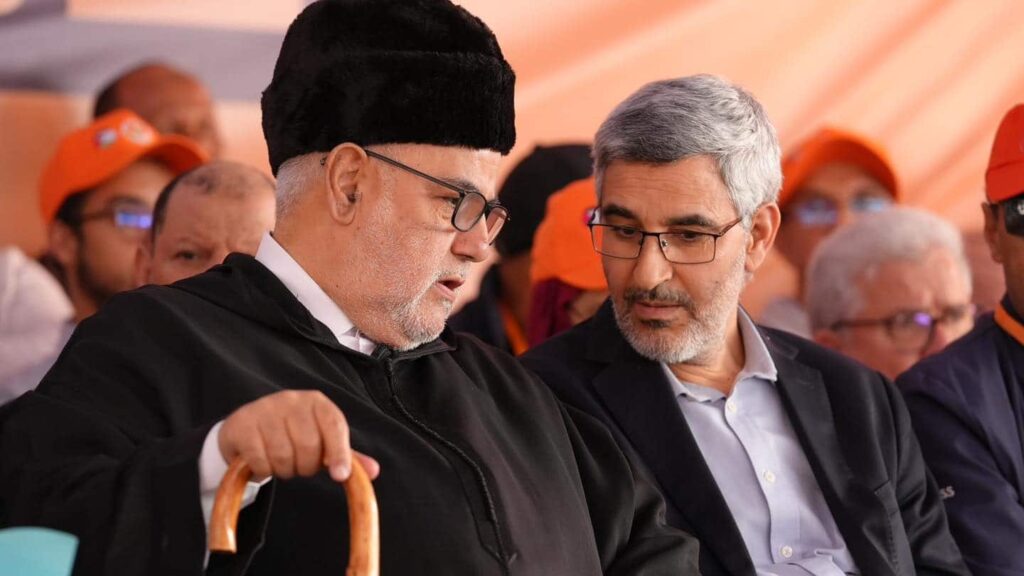
The Justice and Development Party (PJD) has stepped up the pace of its electoral campaign. Campaign rallies have multiplied, even if, as seen in Safi on April 25 and in the days that followed, turnout has remained modest and audience engagement limited.
It was in Safi that Abdelilah Benkirane made remarks that raise questions about his real commitment to the reforms introduced by the Moudawana on women’s status.
The facts:
In Safi, Abdelilah Benkirane delivered a speech (video available through the link, from 1:03:20 to 1:05:00) in which he notably referred to the party’s founding moments and the battles it has fought. Among them, he highlighted the PJD’s opposition to the Plan for the Integration of Women in Development, presented in 1999 by Saïd Saâdi, then a minister from the PPS (Party of Progress and Socialism). That opposition, he said, propelled the party from 14 to 42 seats in Parliament. He described the plan as “contrary to the interests of society” and accused it of being “a national plan whose objective is to alter the Moroccan family”.
In the following parliamentary elections, the PJD thus rose from 14 to 42 MPs. A progression the speaker attributes to the way the party “fought the plan and defended values”.
History has spoken:
The Saâdi plan was indeed withdrawn. But its withdrawal did not amount to a victory for conservatives. In fact, King Mohammed VI set up a royal commission, which worked for two years and whose conclusions led to the 2004 reform of the Moudawana. The King, as Commander of the Faithful, settled the matter. The Moudawana text, submitted to Parliament, was unanimously approved by the members of the legislative institution. Including the PJD.
Why Benkirane’s remarks warrant scrutiny:
The 2004 Moudawana was the result of an arbitration by the Commander of the Faithful. It was therefore natural for the PJD, which likes to invoke Morocco’s Islamic frame of reference, to vote in favor.
But once it did so, is it appropriate to present opposition to the Saâdi plan as a badge of honor? Is the party disavowing a reform it helped adopt?
What this tells us:
This ambiguity is not new. This is not the first time the PJD has struck this chord. In 2015, during a rally in Casablanca, Abdelaziz El Omari, then minister in charge of Relations with Parliament, thought it useful to recall, as a badge of honor, the March 13, 2000 demonstration in Médiouna, which mobilized 500,000 people against the same plan for the integration of women, though far from all of them had answered the PJD’s call. In the context of an electoral campaign, this reminder raised a legitimate question: did Abdelaziz El Omari accept the reformed Moudawana, which he had voted for? And if so, why return triumphantly to an episode that history had precisely made obsolete?
Ideological revisions: how far?
Benkirane himself, during that same 2015 rally, had referred to the “ideological revisions” undertaken by his party on institutions, political violence and the relationship with the state. But on the status of women, he remained silent.
There is a contradiction here that the PJD has never publicly resolved. It deserves to be raised clearly at a time when the party is seeking to rebuild its electoral base and assert a political identity. Voters, and Moroccan women in particular, have the right to know whether the 2004 vote reflected genuine conviction or merely a tactical concession.
There will be a debate this year on the future reform of the Moudawana. The PJD has already taken a position.

à lire aussi
Article : Tunnel de l’Ourika. Pourquoi ce projet à 10 milliards de DH peut changer le destin de tout le Sud-Est du Royaume
Reliant Marrakech à Ouarzazate, le tunnel de l’Ourika figure parmi les projets d’infrastructure les plus stratégiques du Maroc contemporain. Mais malgré les nombreuses relances, aucun calendrier de réalisation clair n’a encore vu le jour, alors que les études de faisabilité restent suspendues au creusement d’une galerie de reconnaissance. Le point sur un chantier à 10 milliards de DH, au croisement d’enjeux techniques, économiques et territoriaux.

Article : Le Maroc en retard sur le Nouveau Modèle de développement, la trajectoire actuelle est insuffisante (BM)
Cinq ans après le lancement du Nouveau Modèle de développement (NMD), le Maroc avance, mais pas encore au rythme requis. Les réformes engagées améliorent la trajectoire, sans suffire à atteindre les objectifs fixés pour 2035. Pour rattraper cette échéance, le pays doit combiner des marchés plus efficaces, des entreprises plus dynamiques et un investissement public mieux ciblé. Il doit aussi mieux intégrer les femmes et les jeunes au marché du travail.

Article : Un droit de réponse de Setrat à Médias24
À la suite de notre article du 2 avril 2026 sur le redressement judiciaire de Setrat, la société nous a adressé un droit de réponse que nous publions ci-dessous.
Article : Élection CGEM. Mehdi Tazi et Mohamed Bachiri dévoilent leur programme avant l'AG élective du 14 mai 2026
À quelques jours de l'assemblée générale élective, les deux candidats à la présidence et à la vice-présidence générale de la CGEM ont présenté un programme articulé autour de l'environnement des affaires, de la souveraineté productive, de l'innovation, du rayonnement international et des synergies internes. Ils portent l'ambition de faire passer la Confédération d'un rôle de plaidoyer à celui de la réalisation et de l'impact.

Article : Coupe du monde 2026. Soufiane Benjdida, un sacré candidat
Meilleur buteur de la Botola Pro, l’attaquant du Maghreb Association Sportive de Fès est impliqué dans plus de la moitié des réalisations de son équipe. Grâce à un ratio qui frise le but par match, l’attaquant met toutes les chances de son côté afin de participer au Mondial 2026. D’autant que ses concurrents ne sont pas dans la forme de leur vie.
Article : Élections 2026 : la FGD et le PSU feront front commun
Réunis séparément le dimanche 10 mai à Casablanca et à Mohammédia, les deux conseils nationaux ont validé des candidatures communes et une répartition des circonscriptions, quatre ans après les divisions de 2021.